
Elf Festival in Hellisgerði 🧚♀️✨
Festival in Hellisgerði – Sunday, 16th August 🌿🧚♀️✨ Come and enjoy the day in Hellisgerði where elves, adventures and joy…
Thorgrimur Óli Cilia –
The mask here is not only a personal veil, but a form that societies and systems can take on. It can be a language, an ideology, a religion, a role or a moral statement that seems to protect what is good, but can also conceal power, fear, control and conformity.
The mask thus becomes not just what a person wears for others, but also what groups, institutions and societies use to justify themselves.
From birth, a person learns what can be seen, what must be hidden, and what role they are to play. More often than not, the mask ceases to be merely a surface that pleases the outside world and becomes the foundation of the individual's identity.
The theme of the exhibition is the origin of the mask: what context creates it, what social forces shape it, and for whom we wear it.
Words, images and symbols shape what we experience, how we interpret the world and how we learn to interpret ourselves. The mask is therefore not only a personal symbol, but part of a larger social system: how society distinguishes, labels and categorises individuals according to standards that later appear to us as self-evident.
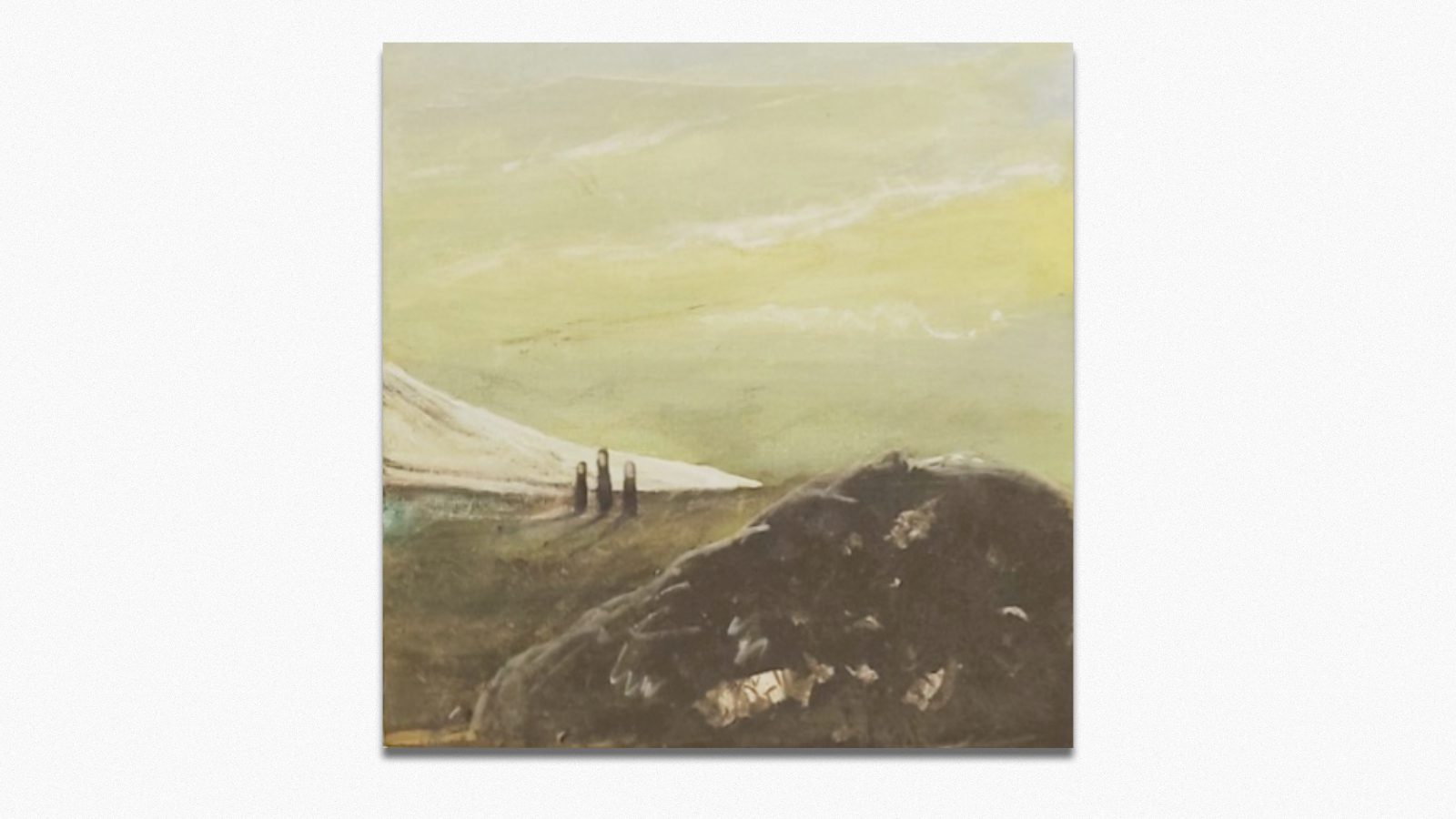
In the paintings of the exhibition, this struggle is interpreted through faces, bodies, colours, texture, repetition and atmosphere. The figures seem to stand on the verge of being human, symbols or concepts. Some of the faces are white and clear, others dark, cracked and faded. The bodies leak, thin out or dissolve into the background.
The artworks are based on a recurring tripartite division that refers to the shaping of norms, roles, opinions and behaviour that society has already defined as appropriate. This approach draws on older ideas of the triadic division of forces: solid, liquid and gaseous; creation, preservation and destruction; Brahma, Vishnu and Shiva; sattva, rajas and tamas.
Over time, the masks become so ingrained in the identity that neither the individual nor others can any longer clearly distinguish between the person herself and the script that accompanies her status, role and social meaning.
The mask is then no longer something worn over a real face. It becomes an integral part of it.
Curator: Elvar Gunnarsson
There will be a special exhibition opening on Thursday, 11th June from 18:00-21:00 and you are welcome!
Other opening times:
Friday 12 June, 14:00–18:00
Sat. 13 June 13:00 - 17:00
Sun. 14 June 14:00 – 17:00
Wed. 17 June 12:00 - 21:30
LG // Litla Gallerý is supported by the Culture and Tourism Committee.
Hafnarfjörður's due to the event
—————————–
Thorgrimur Óli Cilia –
The mask here is not merely a personal veil, but a form that societies and systems can assume. It may take the shape of language, ideology, religion, a role, or a moral declaration that appears to protect what is good, while also concealing power, fear, control, and adaptation.
The mask thus becomes not only something a person wears before others, but also something that groups, institutions, and societies use to justify themselves.
From birth, the individual learns what may be seen, what must be hidden, and what role they are expected to perform. More often than not, the mask ceases to be merely a surface designed to please the outside world and becomes part of the foundation of the individual's identity.
The subject of the exhibition is the origin of the mask: what chain of causes creates it, what social forces shape it, and for whom we wear it.
Words, images, and signs shape what we experience, how we interpret the world, and how we learn to interpret ourselves. The mask is therefore not only a personal symbol, but part of a larger social system: the way society identifies, marks, and categorises individuals according to standards that later appear to us as self-evident truths.
In the paintings in this exhibition, this tension is interpreted through faces, bodies, colours, texture, repetition, and atmosphere. The figures seem to stand on the threshold between being human beings, symbolic forms, and concepts. Some of the faces are white and distinct; others are dark, fractured, and worn away. The bodies leak, thin out, or dissolve into the background.
The paintings are built around a repeated threefold structure that refers to the formation of norms, roles, beliefs, and behaviours that society has already defined as appropriate. This approach draws on older ideas of a triadic division of forces: solid, liquid, and gaseous; creation, preservation, and destruction; Brahma, Vishnu, and Shiva; sattva, rajas, and tamas.
Over time, the masks become so fused with identity that neither the individual nor others can clearly distinguish between the person themselves and the script attached to their status, role, and social meaning.
The mask is then no longer something worn over a real face. It becomes an inseparable part of it.
Curator: Elvar Gunnarsson
There will be a special exhibition opening on Thursday, 11th June from 18:00-21:00 and you are welcome!
Festival in Hellisgerði – Sunday, 16th August 🌿🧚♀️✨ Come and enjoy the day in Hellisgerði where elves, adventures and joy…

