
Diverse exhibitions in several locations
The Hafnarfjörður Folk Museum has two new exhibitions this summer. One is an exhibition in the forecourt of the Packhouse of folk art objects from the collection of Þorbjörg Bergmann, and the other is a photography exhibition on Strandstígur. There are also permanent exhibitions in several houses in the town.
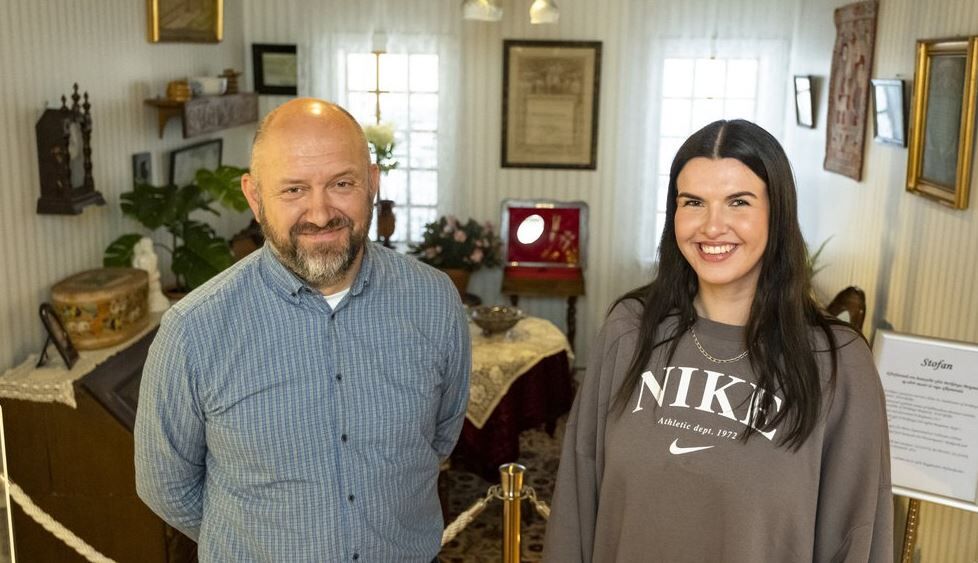
Hafnarfjörður Museum of Local History is having two new exhibitions this summer.
There is, on the one hand, an exhibition in the forecourt of the Packhouse of national artefacts from the collection.
Thorbjorgar Bergmann and then there is a photography exhibition at Strandstígurinn. Then there are
Permanent exhibitions in several buildings in the town.
 Björn Pétursson, the town's antiquary, and Bryndís Lára Bjarnadóttir, curator at the Folk Museum. FRÉTTABLAÐIÐ/ERNIR
An interview with Björn Pétursson was published in Fréttablaðið on 13 July 2022.
Every spring, sets Hafnarfjörður Museum of Local History up new
A themed exhibition in the foyer of the Packhouse, and this summer's exhibition is about Thorbjørg.
Bergmann. „She was the first collector from Hafnarfjörður.“ says Björn Pétursson
Town Curator of Antiquities. „She lived in Hafnarfjörður from 1900 to 1930 and for the entire time
she collected national artefacts both in Hafnarfjörður and outside Hafnarfjörður and laid
a lot came of it. With this exhibition, we are both telling her story and
show some of the items she collected. The exhibition is produced in close collaboration
with the City History Museum and one of Thorbjorg's descendants who lent us both a great deal of
objects and images, and many of these items are incredibly beautiful and remarkable.
Thorbjorg was a great needlewoman and her interest in Icelandic is evident in the exhibition.
craftsmanship. She herself was a multi-award-winning needlewoman and Þorbjörg,
with Katrín Briem, for various handicraft courses for girls in
Hafnarfjörður.
 In one of the bays at the Hafnarfjörður Folk Museum, it is shown how
Soldiers lived in Iceland during the occupation years. It's interesting and fun to look at.
Þorbjörg realised during these years that Icelandic society
was changing – it was this urbanisation and the farming community was giving way
She saw that things were being lost as a result of this change, and she left.
to this collection of theirs to preserve Icelandic culture; to save
rescued from oblivion and collected over 400 artefacts.
Thorbjorg moved to Reykjavik in 1930 to her daughter.
and her son-in-law, and after her death, they gave her collection, these 400 items, to the Reykjavík Society.
and this was the largest gift to Árbæjarsafn when it was opened.
The City History Museum lent us some of these items to have on display.
for the exhibition, and we also borrowed items from Thorbjorg's descendants.“

The toy collection gives people the opportunity to see all sorts of treasures.
from the past.
Photographic exhibition on the Strand
The Hafnarfjörður Museum of Local History has exhibition space for
its photography collection on Strandstígur along the harbour in Hafnarfjörður, and are there
Annual photography exhibitions are held, highlighting daily life and history.
the people who lived in the town. „This year there are 52 pictures and the exhibition is called My Town.
These are photographs that Anna Jónsdóttir took from 1920-1940 and are
Lifestyle photos from Hafnarfjörður. These are incredibly fun and beautiful.
Photographs providing an insight into the town's development from this period.
Anna was a photographer in Hafnarfjörður and was closely connected to the town.
She ran a photography studio there for a long time, and her photography collection, or film collection,
preserved at the folk museum and has been there for decades. This is largely
a film collection on glass plates and some of these films that we are showing now have
not previously published to our knowledge; at any rate not in recent years. Part of
These pictures were featured in a book published in 1933, so this
There are pictures that have been forgotten, but others are well-known and have been in exhibitions.
with us.“

From an exhibition about Þorbjörg Bergmann, who was the first person from Hafnarfjörður
The collector. The exhibition was opened at the Folk Museum on 1 June and is still on display.
The History of Hafnarfjörður
The Hafnarfjörður Folk Museum has more exhibitions, regardless of
summer shows. „We have exhibitions all over town. At the Packhouse there is
A large exhibition about the history of Hafnarfjörður, spread over two floors. It is called 'Thus It Was and Is'.
The history of Hafnarfjörður from the settlement era to the present day. Here we trace the history
of the town through certain themes and we shed light on the town and village both with
historical texts, photographs and then a large collection of artefacts. We put this
down into a pit and, for example, in one place from the shopping town, in another place
from the fishing villages and the third since the occupation. This exhibition is updated on
every year, so there's always something new to see on it. Now in the spring
For example, we set up a small shop stall; an old co-op. That's the novelty on
that show this year.“
A toy exhibition is on the top floor of the Packhouse. „There we are
We have all sorts of toys and other things for children. It's absolutely
a non-verbal show specially designed for children; this is more
an immersive exhibition. For example, there are old video games that you can play.,
among others, Space Invaders and Super Mario Bros.“

A herring curing shed from the 1960s-1970s which can be viewed at the museum.
Different homes
The Sívertsens House is the oldest house in Hafnarfjörður and it was built in 1680.
Built by the contractor Bjarni Sívertsen between 1803 and 1805. „He has been
called the „father of Hafnarfjörður“. He was the first Icelandic merchant after
We broke away from the monopoly and he built the Sivertsen House for the family.
his and a shop next door. Bjarni's story is in many ways very remarkable and
It is somewhat reflected in the house. We show how an upper-class family
lived at this time and we trace the story of Bjarni and his wife, Rannveig.“
Siggubær, which stands on Kirkjuveg, is an example of a home.
of a worker and a sailor in Hafnarfjörður from the first half of the 20th century where visitors
can experience and learn about how the town's ordinary people lived at that time, but that
Erlendur Marteinsson was the sailor who had the house built. „Siggubær is typical of these houses that were in
Hafnarfjörður at this time – these working-class homes; the definition of a 'bæ' versus a 'hús'.
is that it has low walls and the windows are only on the gables.“

The Merchant of the Corner was a summer show last year and was part of
hers was added to the permanent exhibition last May.
Foreign fishing
The Bookless Bungalow, located at 32 West Street, was
built in 1920 for the Scot Douglas Bookless but he and his brother, Harry,
In the first half of the 20th century, they had run an extensive fishing operation from Hafnarfjörður. „At that time, foreign fishing was very strong and extensive in
In Hafnarfjörður, and in the house, we tell both the story of the Bookless brothers and also this one.
the large foreign fishing fleet that was in the town. We are telling the story of the foreign fishing fleet.
in the first decades of the 20th century. The brothers had all sorts of innovations which
The Icelanders were not known at this time, but they, for example, laid out tracks.
from the drying houses up to the saltfish yards. There were all sorts of innovations that they
presented to the nation, and particularly that which concerned fisheries, shipping and
fish processing.“
Retail Heritage Exhibition
The Trading Post Museum of the Hafnarfjörður Folk Museum is in Beggubúð.
„This is an old warehouse that previously stood on Strandgata and was moved to the site.
of the folk museum and an exhibition was opened there in 2008. This is an original building with
with original fittings, and we have set up an old-fashioned shop there, just like they used to be.
were on the last century. This is a house that many remember on Strandgatan and
Many have a connection and feelings for it. There, we have also taken pride in
set up special window displays for various occasions. We set up to
for example, a special window display for 17th June and another for Christmas. Although
When the museum is closed, we have these big windows with something fun.
exhibition.“ ■