
The year is 1951 – a celebration in honour of the 70th anniversary of the residents of Hafnarfjörður.
For the past two days, celebrations have been held in the High Hall of Hafnarfjörður Church in honour of residents born in 1950 and 1951. The celebrations are a tradition that has developed in recent years, and this is the seventh such birthday party. The Mayor of Hafnarfjörður hosts the celebration.
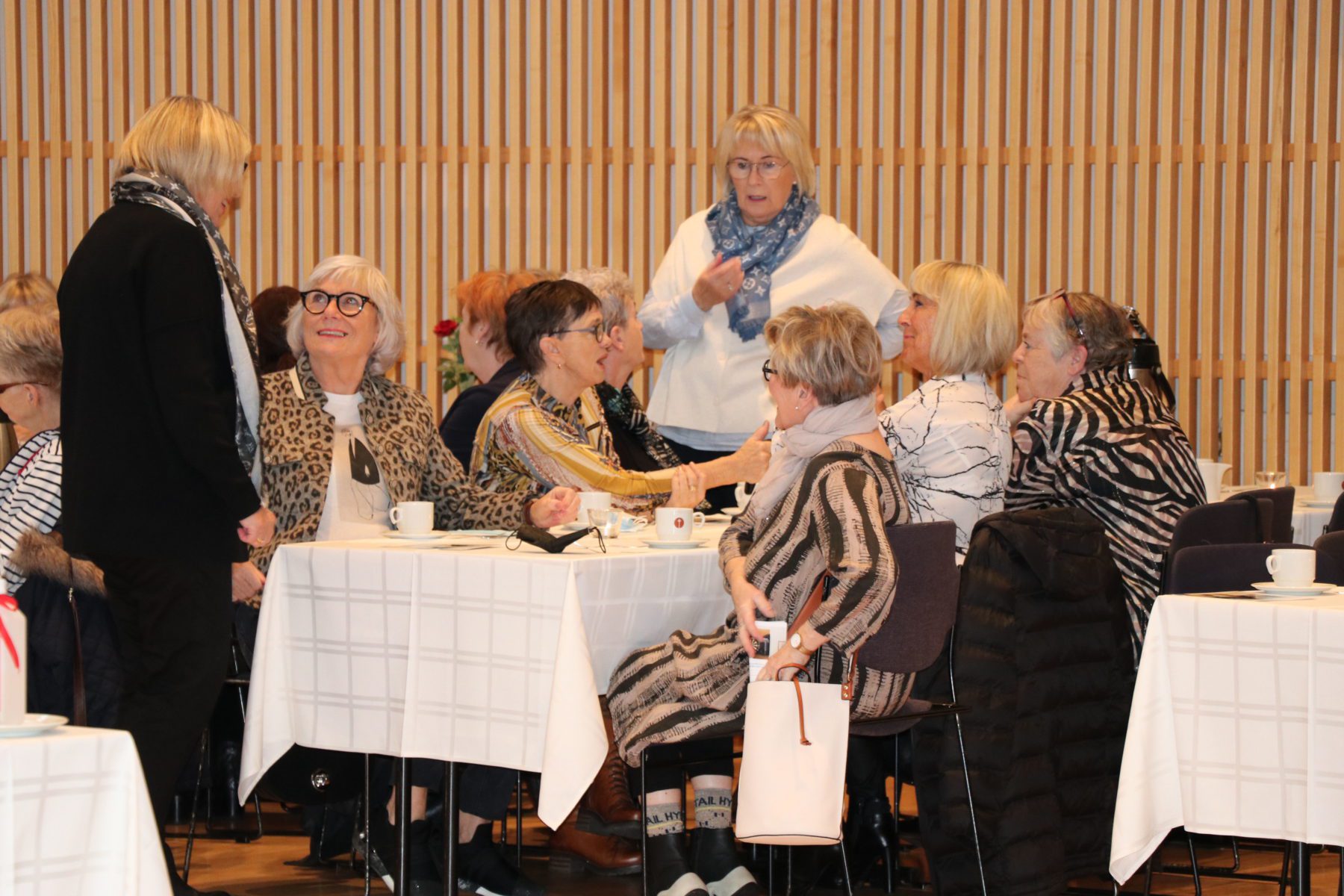
Over the past two days, celebrations have been held in the High Hall of Hafnarfjörður Church in honour of residents born in 1950 and 1951. The occasion is a birthday party for those Hafnarfjörður residents who turned seventy in 2020 and who will turn or have turned seventy in 2021. The celebration is a tradition that has developed in recent years, and this is the seventh of these milestone birthday parties. The Mayor of Hafnarfjörður is hosting the event.

Around 90 cheerful residents of Hafnarfjörður gathered in Hásölum yesterday, where they met former mayors, town staff and, last but not least, childhood friends, former classmates and fellow members of various social groups. The group listened to soft, melodic tones, was given a presentation on Hafnarfjörður's services for senior citizens, a varied social life at Association of Senior Citizens in Hafnarfjörður as well as listening to interesting and entertaining stories from the year of birth 1951 from the town's archivist.
More photos from the birthday can be found on Hafnarfjörður's Facebook page
Stories from the year of birth 1950
The year 1951 has gone down in history for many reasons. In the history of humankind, the year is chiefly remembered for the invention of the heart-lung machine, the start of nuclear power generation in the United States, the opening of the United Nations Headquarters in New York, and the ongoing Korean War, Stalin declared that the Soviet Union had developed nuclear bombs, and the Rosenbergs were the first people in the United States to be sentenced to death for espionage, accused of leaking information to the Soviet Union that helped them to develop the aforementioned nuclear bombs. Famous people born in 1951 include Sting, Jane Seymour, Phil Collins and Bonnie Tyler.
In Iceland, the following was of most note….
In the history of Iceland, the main events were the return of the American Army to Iceland following the signing of the defence agreement, the aeroplane Glitfaxi crashed in Faxaflói, killing 20 people, The National Gallery was opened in the National Museum building, the patrol vessel Þór arrived in the country, and the classic radio programme „Patients“ Wishes' began on the state broadcaster.
In Hafnarfjörður, the following were the main news items….
Here
In Hafnarfjörður, a few other interesting things also happened in 1951. The year began in
to the town's cinemas with the film „Glad Youth“, which was fun and lively.
a new American film at Hafnarfjarðarbíó and the very entertaining and beautiful American
a musical film in natural colours „Romance on the high seas or musical magic in
Town cinema.
The employment situation
The town was in a dire state at the beginning of the year, so dire that the Hlíf Trade Union
sent a communication to the town council requesting that the number be increased in
the town's work and that the old town's fishing trawlers would be put to sea again. It was
however, such that due to the high price of coal at that time, it was clear that
These trawlers would be operated at a loss of 100,000 krónur per month, and therefore it was
It was not possible to comply with this request. Emil Jónsson had then tried to secure funding.
from the treasury to convert the trawlers and install oil-fired boilers in them, but that did not materialise. In connection with this, it was decided to call on private enterprise
The town's fishing companies land their catch here and have it processed in the town.
rather than sailing it unprocessed to the English market, as the Municipal Fisheries had
when the decision is made to do it.
In March
was partially rectified when Júní, the new trawler of Bæjarútgerðar Hafnarfjarðar
It came to its home port for the first time. It was in every respect a most splendid fishing vessel.
and the most perfect thing that had been made from the town. June was one of
of the 10 trawlers that the government had contracted for construction, but when he arrived
A great festival was held in Hafnarfjörður and many local residents made the trip.
down to the quay to receive the ship despite the cold weather.
The year
In 1951, the first Hafnarfjörður ski competition was held; it was a cross-country ski competition.
ÍBH organised it in collaboration with the primary school, and there were just over 60 competitors.
of the count. For some time leading up to the competition, Gudjón Sigurjónsson had been organising
training to prepare competitors, but the competition was held at Setbergstúni and
It attracted a great deal of attention and was a resounding success.
Through
In the old days, it was customary to call upon the scouts in the town whenever something needed fixing.
Ah, when people had to be searched, etc. An example of this was when the aeroplane
Geysir made a forced landing on the Vatnajökull glacier in the autumn of 1950; on board were, among others, several scouts from
The harbour authorities were brought in to assist with the search. This resulted in early
In 1951, 18 members of the Hraunbúar Scout Group came together and founded
The Hafnarfjörður Scout Rescue Squad. The purpose was to have a special unit in the town.
A Scout troop whose main objective was rescue and relief work.
The auxiliary corps was initially a section within the Hraunbúar Scout Association, but however
with separate finances.
It was
also this year, Rafha, in collaboration with the engineering firm Héðinn, decided to produce
combined washing machines. These were machines that were named Mjöll and they were
advertised as suitable, sturdy and inexpensive. People had to order the engines
in good time and pay a confirmation fee. Upon payment of this, people received
numbers were handed in and the machines were processed accordingly. It was noted that
Their sale began half a year before delivery and, due to inflation, the price was fixed.
up to 3,000 kr based on the price at the time, but it is open to the possibility that they may have increased in price by the time of delivery.
Á
In the spring of 1951, the Fegrunarfélag Hafnarfjarðar was founded in the town for
by the Hafnarfjörður Rodeo Club. The purpose of the association was to work on
to beautify the town and to provide assistance and support to its residents for that purpose. The association
provided great assistance to garden owners and, among other things, arranged for gardens to be sprayed
in addition to which it had an adviser who guided people
regarding gardening. The society then held a competition and awarded prizes and
Awards for beautiful gardens and tidy surroundings.
Annual General Meeting
ÍBH put forward two interesting challenges to the town this year. In the first
It seems that the town and the state's sports representative pushed for it to be done.
to the swimming pool building, but at that time the swimming pool was an outdoor pool. Then
The town council was urged to buy Víðistaðir and to get started straight away.
construction of a sports stadium there for Hafnarfjörður in accordance with the drawings
which were on the table. As for the first point, it suffices to say that the State's Finance Council
rejected Hafnarfjörður's application for an investment permit for the superstructure.
That decision was appealed and the permit was eventually granted, and work began on it.
Late-year project
This year
like many of its predecessors, it was characterised by extensive construction work.
the harbour in Hafnarfjörður. Work on the southern pier began in 1948 and its purpose was
to defend the harbour from the south-westerly direction. What happened most notably in that
The execution in 1951, which attracted great attention, was when a Dutch tugboat
sailed into the harbour early in the morning on a beautiful June day with a 62-metre-long
An invasion system in the rear. It was one of those systems that the Allies
were used during the invasion of Normandy at the end of the Second World War. The units were used there to establish temporary harbours on an open beach but
This system and another similar one that arrived in the autumn months were used in the making.
of the harbour wall and a quay there. The other was sunk inside the front of the wall but
The other was used as a tug quay inside it.
About
The autumn term began with the reopening of the Music School, and attention was drawn to a new initiative.
his activities. The innovation was that instruction in art dance was introduced and
ballet, and Sigríður Ármann had been appointed as a teacher in that discipline. It was stated in
A news report from the school stated that ballet was considered by many to be the most perfect art form.
Artistic expression. Dance was also considered to enhance sensitivity to rhythm and music.
which refines and polishes people's behaviour and customs.
About
In the autumn of 1951, a new factory began operations in Hafnarfjörður, but it was
The rock wool factory which stood at the junction of Lækjargata and Hringbraut. Factory
This was at the time considered a great technological marvel, but the operation consisted of this
to melt stone at a temperature of 1400-1500 degrees and then blow air or steam through it
the mass and thus form rock wool. The factory was powered solely by electricity.
but because of the great deal of energy it required, it could only be operated
when electricity consumption in the town was low, in the summer and at night.
Decided
were carrying out an experiment with improvements to the town's street lighting in 1951 and were
Concrete posts with fluorescent lights were erected on Strandgatan. It was about
to discuss an innovative experiment that appeared to be very successful. The start-up costs of these
The light was great, the poles were large and substantial, but the running costs were
significantly lower than that of conventional streetlights, the electricity consumption was only about
one third of what it was before, but the light intensity was three times greater. Previously,
an experiment was carried out with a so-called „sodium lamp“ at the top of the Reykjavik Road but
Its disadvantages were that the light's colour was not sufficiently pleasant, for example.
her red lips turned blue and her complexion became completely pale and wrinkled, and came
They therefore do not consider those lamps.
From
In police matters, it was reported early in the year that a news story was published about
that a prisoner had escaped from the prison in Hafnarfjörður. It concerned 18
a boy who got out of his cell by breaking the window frames, but
This was the second time in a short space of time that this same prisoner had broken out.
the prison in Hafnarfjörður. Whether there was a connection between them shall be left unsaid, but
On that same night, Einar Sigurjónsson's barber's shop was broken into at
The Strand and stole from there a 40–50 krone coin.
At the end of the year
In 1951, the Hafnarfjörður Angling Club was founded in the town, and the founding members were
just over 40. As the association was founded at the end of the year, this activity was not
a great deal that year, but the very next spring a contract was made for the right to hunt in
Hlíðarvatn in Selvogur.
The year
ended up just as the years generally did in Hafnarfjörður at that time, with
Christmas tree parties at the Good Templar Hall and Christmas films in the town's cinemas.
At Hafnarfjörður Cinema, this year's Christmas film was an American revue film which featured
the name „A Bit of This and That“, but at the Town Cinema the explosively hilarious new one was shown
The Swedish comedy film „Poor Little Swain“ was shown to great popularity.
Sources
- The Morning Newspaper, 3 January 1951, p. 9
- Alþýðublað Hafnarfjarðar, 03. 03. 1951, p. 1
- Alþýðublað Hafnarfjarðar, 03. 03. 1951, p. 2
- Alþýðublað Hafnarfjarðar, 17 March 1951, p. 1
- Alþýðublað Hafnarfjarðar, 17 March 1951, p. 2
- The History of Hafnarfjörður, 1908–1983, 3 volumes, p. 144
- Alþýðublað Hafnarfjarðar, 28 April 1951, p. 3
- The History of Hafnarfjörður, 1908–1983, 3 volumes, p. 113
- Alþýðublað Hafnarfjarðar, 28 April 1951, p. 3
- Alþýðublað Hafnarfjarðar, 23 June 1951, p. 4
- The Morning Newspaper, 07.09.1951, p. 8
- Alþýðublað Hafnarfjarðar, 15 September 1951, p. 2
- Alþýðublað Hafnarfjarðar, 13 October 1951, p. 1
- Alþýðublað Hafnarfjarðar, 10 November 1951, p. 1
- The Morning Newspaper, 20 March 1951, p. 1
- The History of Hafnarfjörður, 1908–1983, 3 volumes, p. 172