
Digital HR solutions deliver 22.6 million in annual savings
A complete transformation has taken place in working practices for payroll and human resources at Hafnarfjörður Municipality in recent years. The biggest factor in these changes has been the use of electronic signatures and the implementation of a new HR and payroll system. According to a recent benefits realisation assessment, this implementation has delivered a total annual saving of 22.6 million króna.
Tackling a Covid challenge
The City of Hafnarfjörður has around 2,300–2,500 employees, and in addition, about 1,000 staff are employed during the summer.
At the start of 2020, the municipality faced significant challenges, like everyone else, with the Covid pandemic. Ahead was the recruitment of around 1,000 staff for summer jobs, in addition to a large number of regular hires. At that time, applications could be submitted via a recruitment website, but a great deal of manual work then followed in the hiring process. It was unthinkable to bring a large group of applicants and managers into the building to sign documents and submit paperwork, given the risk of infection involved.
So, good advice was hard to come by. The only right move was to implement electronic signatures. By no longer requiring applicants and managers to come into the office to sign and submit documents, there are also significant environmental savings: the carbon footprint is reduced, fewer car journeys are made, and kilometres are saved. A great deal of work has been saved in printing out documents, filing them in folders, scanning materials and inputting them into the system.
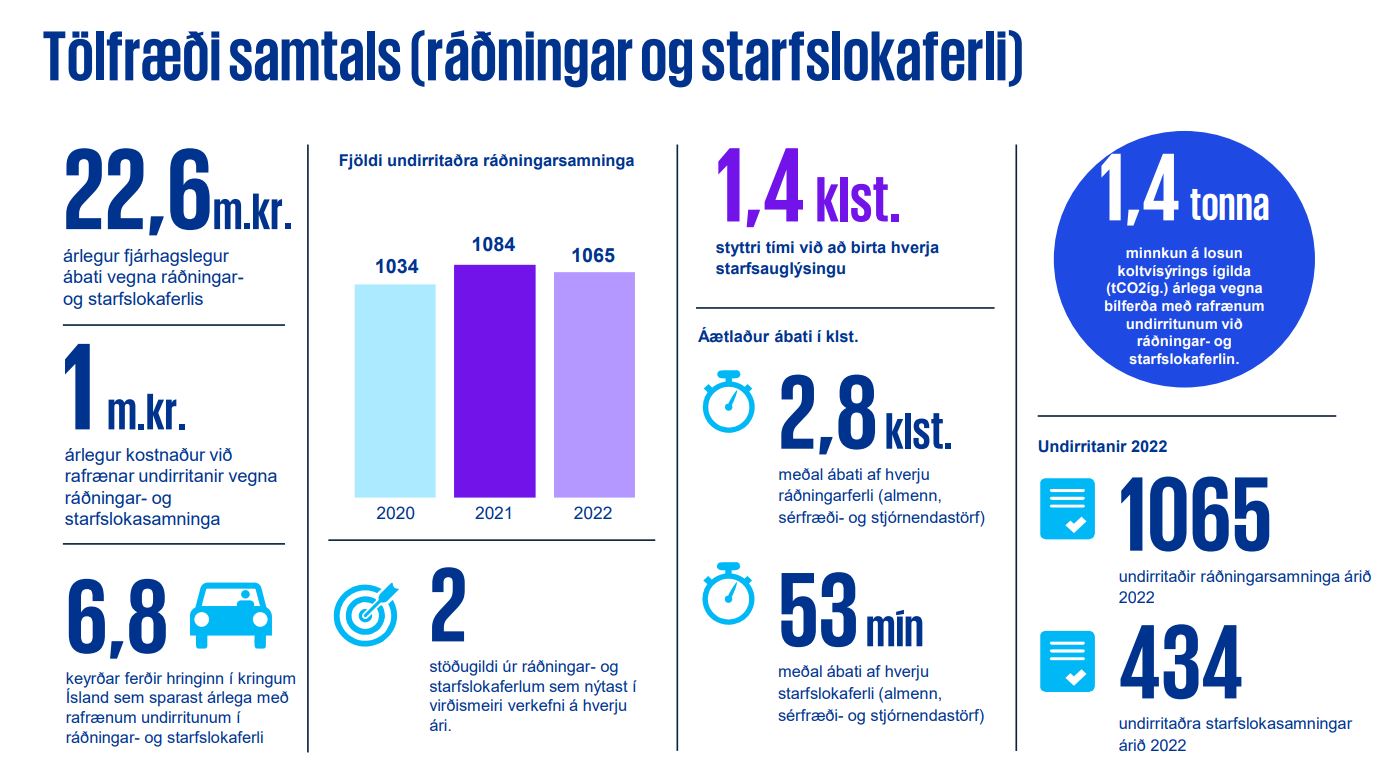
The volume of electronic signatures has become considerable, with a total of 1,065 employment contracts signed in 2022, of which 300 were for specialist and managerial roles.
It is estimated that around 20% of the work of staff, for example in the payroll department, previously went into all sorts of paperwork. But today, paper-based documents are only accepted in exceptional circumstances. Staff can instead better fulfil their role of supporting, for example, managers, and develop their careers.
The recruitment process today
Today, no employees can start working for the council unless they have been set up in the payroll and HR system. Once a decision to hire has been made, notifications are sent to the payroll department, which sets up the individual in the Core HR and Payroll system. The staff there review the employment contract and send it out for electronic signature, along with any relevant supporting documents.
Furthermore, a notification is sent to the Development and IT Department, which creates the relevant user account and grants access to the appropriate systems, as well as providing the necessary equipment. The Service Desk prepares the issue of a staff ID card, which grants access to the areas, printers and other systems specified in the registration.
These new procedures have greatly eased the burden on managers at large workplaces who need to hire many employees each year, and this is particularly true of the school system. Valdimar Víðisson, headteacher and chairman of the town council, put it this way at conference on digital transformation November 2022: „This is a complete revolution in school life, a good addition and a great step forward.“
In addition to implementing electronic signatures, all teacher work reports are now recorded electronically. An effort has also been made to convert all job descriptions into an electronic format; new job descriptions are written in the HR system and go through an electronic signature process. Older job descriptions have been scanned in recent summers as part of a special initiative.
To further support managers' self-service, a new HR system – Kjarni – was implemented in spring 2022, where managers have the payroll, HR, and recruitment systems in one place. The system is simple, user-friendly and accessible, which has considerably simplified managers' tasks with the recruitment process, pay agreements and other HR processing. The experience for managers is positive due to the change in procedure, and there is no doubt that bringing the recruitment process into a modern and user-friendly format enhances the employer brand.
KPMG Value Assessment
In spring 2023, a decision was made to seek assistance from KPMG to assess the benefits of implementing electronic signatures and the HR solution, Kjarna. The project was completed in just under a month, and the findings are based on interviews with staff who participated. Workshops were organised with key stakeholders, where current processes were mapped out, compared with previous procedures, and the time taken before and after the new procedure was assessed.
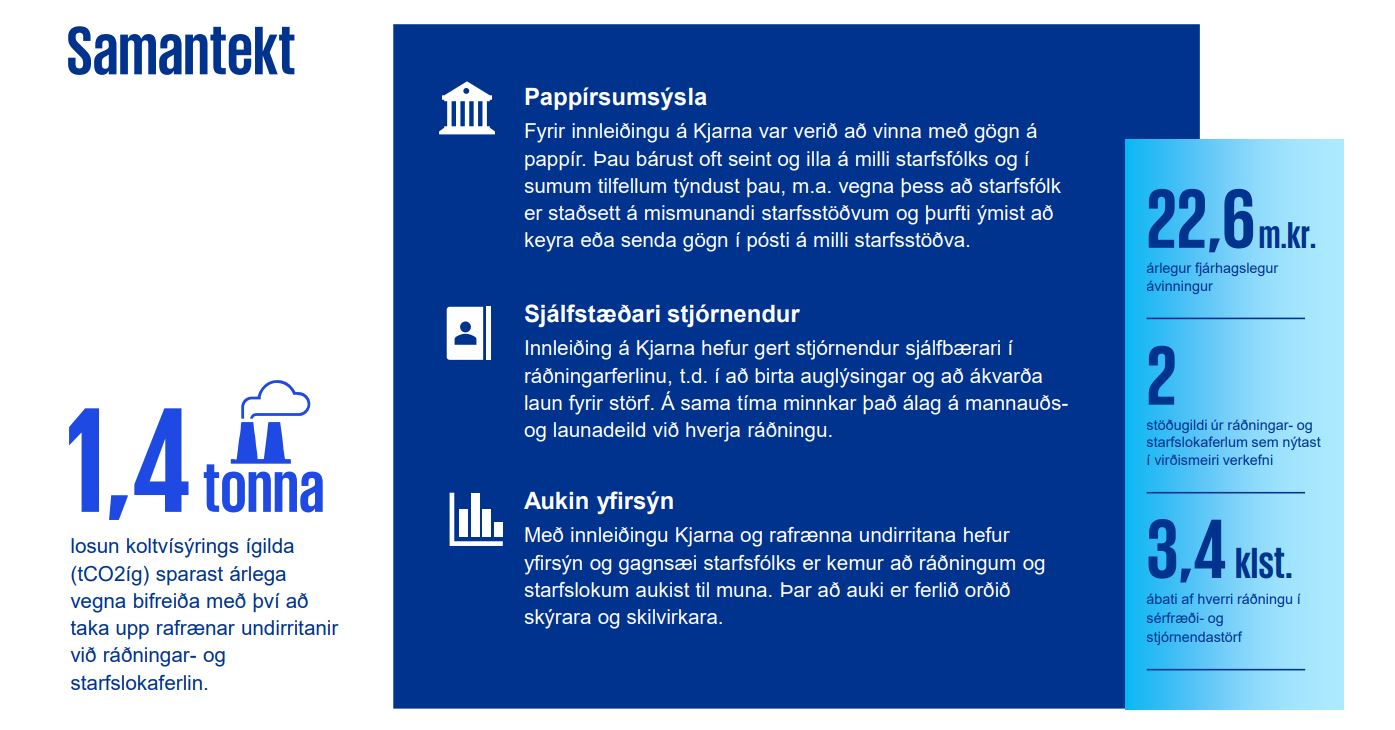
Key findings in figures
- The annual financial benefit was estimated at 22.6 million.
- 2 full-time positions Resources from recruitment and dismissal processes are utilised for higher-value projects.
- The benefit from each recruitment to specialist and management positions was estimated at 3.4 hours
- It took 1.4 hours shorter time to publish each job advertisement
- Lower emissions of carbon dioxide equivalents were assessed at 1.4 tonnes annually, where electronic signatures significantly reduced car journeys
- The cost of electronic signatures versus was estimated at around 1 million.
Summary in words
PaperworkBefore the implementation of Kjarna, data was processed on paper. They were often late and poorly handled between staff, and in some cases, they were lost, partly because staff were located at different sites and had to either drive or post documents between them.
More independent managers: The implementation of Kjarna has made managers more self-sufficient in the recruitment process, for example in publishing advertisements and determining salaries for positions. At the same time, it reduces the burden on the HR and payroll department for each recruitment.
Increased overview: The implementation of Core and e-signatures has significantly increased the oversight and transparency for staff regarding recruitment and terminations. Furthermore, the process has become clearer and more efficient.
KPMG report
Attached is the KPMG benefits realisation assessment, with process diagrams of the as-is and to-be processes. The document contains a more detailed analysis of the project, statistical assumptions and detailed processes.