
Digitalisation of building permit applications saves 14.7 million annually
Over the past year, we have systematically digitised the building permit process and a benefits assessment has been carried out for the project. In short, the digitisation has delivered annual benefits of 14.7 million króna (kr).

Prioritisation in digital transformations is important. Some of the projects can be very important but complex and difficult to implement. Infrastructure may not be good, it is difficult to find suitable software and even staff are not receptive, which is usually the most difficult obstacle.
We in the digital team at Hafnarfjörður Municipality had long been keeping an eye on the construction matters. We felt there was a great opportunity there, but somehow it wasn't obvious how we would approach the project. It was complex, and in the early years of digital transformation, it was easier to tackle other projects that were indeed also important, but at the same time more straightforward.
Last year, it all came together. We had created space for large and complex projects. We had good personnel, the staff involved in building matters were receptive, we found a proven technology solution from Taktikal, and we entered into a good collaboration with another municipality, Reykjanesbær, which in many respects had spearheaded these changes. An opportunity had therefore arisen to transform the town's building permit process. Now it was time to tackle this tall order.
Benefit assessment
Over the past year, we have systematically digitised the building permit process and are proud of the result. We had a good feeling that with the changed process we had achieved tangible results, not just in the service experience but also in the optimisation of staff and applicants' time, costs, printing and, not least, environmentally.
We had KPMG evaluate the benefits at the end of last year, by which time we had several months of experience with the project and staff and clients still had a fresh memory of how things were done previously. The project compared procedures from 2019 with those from 2023.
The results of the benefits assessment are based on interviews with staff from the City of Hafnarfjörður who participated in the project. The applicants' benefits were also assessed based on interviews with the building supervisor and master craftsmen who had applied for the permit before and after the changes.
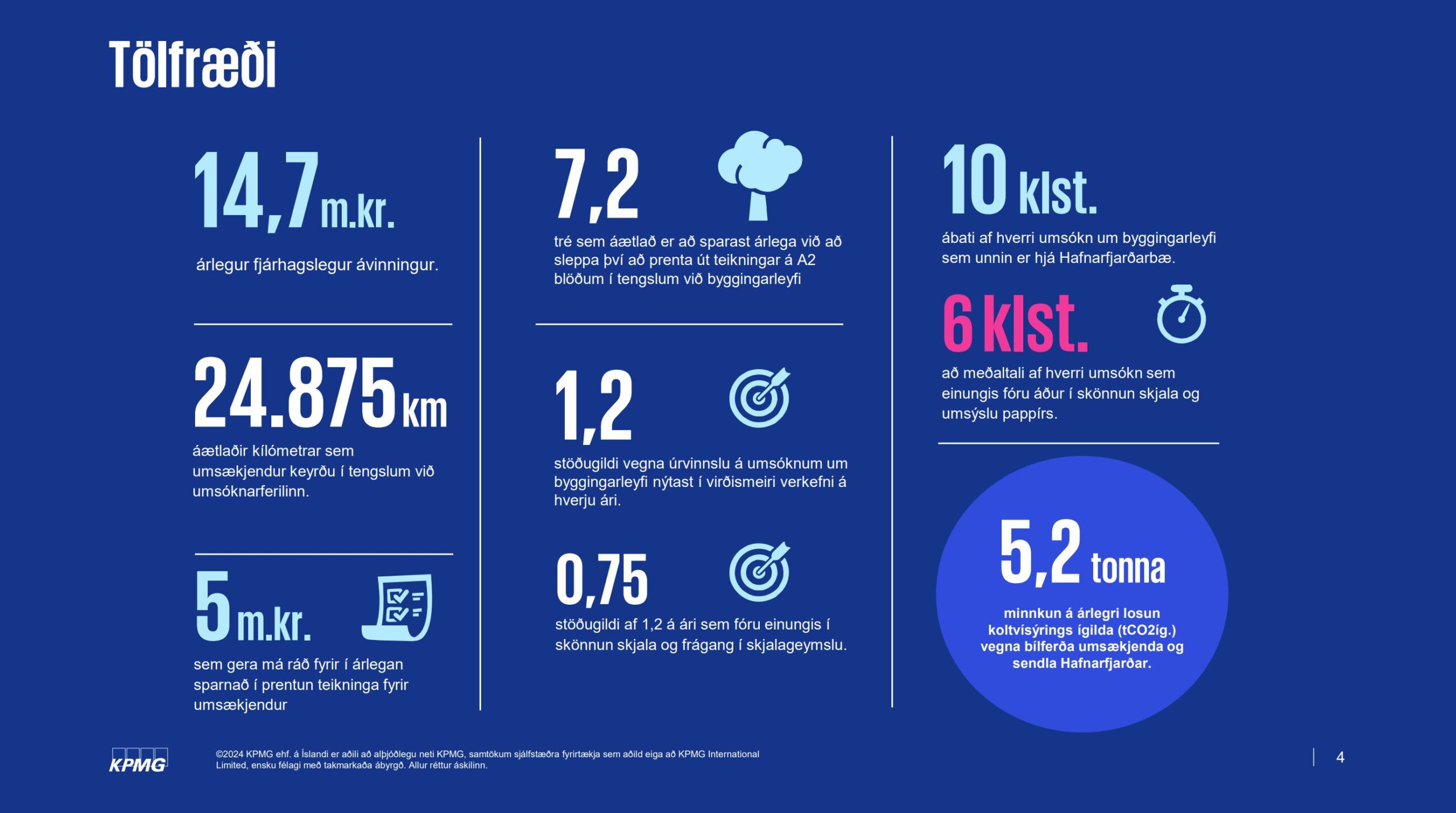
In short, the digitisation has delivered annual benefits of 14.7 million króna (m.kr.), freeing up staff to focus on other tasks or the equivalent of 1.2 full-time positions, 10 hours. is saved per application processed, nearly 25,000 kilometres are no longer driven in connection with the process, and 5 million króna in printing costs for applicants and lower carbon dioxide emissions equivalent to 5.2 tonnes in total due to fewer journeys by applicants and council vehicles.
When we go through digital transformation, it's not just for the sake of it. The projects must have a clear purpose and benefit. And we can't just assume that the projects are delivering benefits. They must be measured, and that's what we did, just as was done with the digitisation of HR for the council last year.
So what has become digital in the process?
- The application is electronic as before.
- Registration of building surveyors, tradesmen, designers and design managers with a check of their rights in the HMS rights database. Registration cannot be completed unless the rights are valid.
- Return of self-drawn plans and drawings (no paper!)
- Statements and supporting documents
- All signatures in the process are electronic.
- Drawings are electronically sealed with a watermark.
How was the benefits assessment conducted?
During the project's development, both the previous and current processes for building permit applications in Hafnarfjörður were mapped out, and staff recorded how long each step took in minutes. The process covers everything from applying for a building permit to the completion of final inspections on the building. The process can therefore take several years from start to finish. Applicants for a building permit can be landowners, building managers and/or designers.
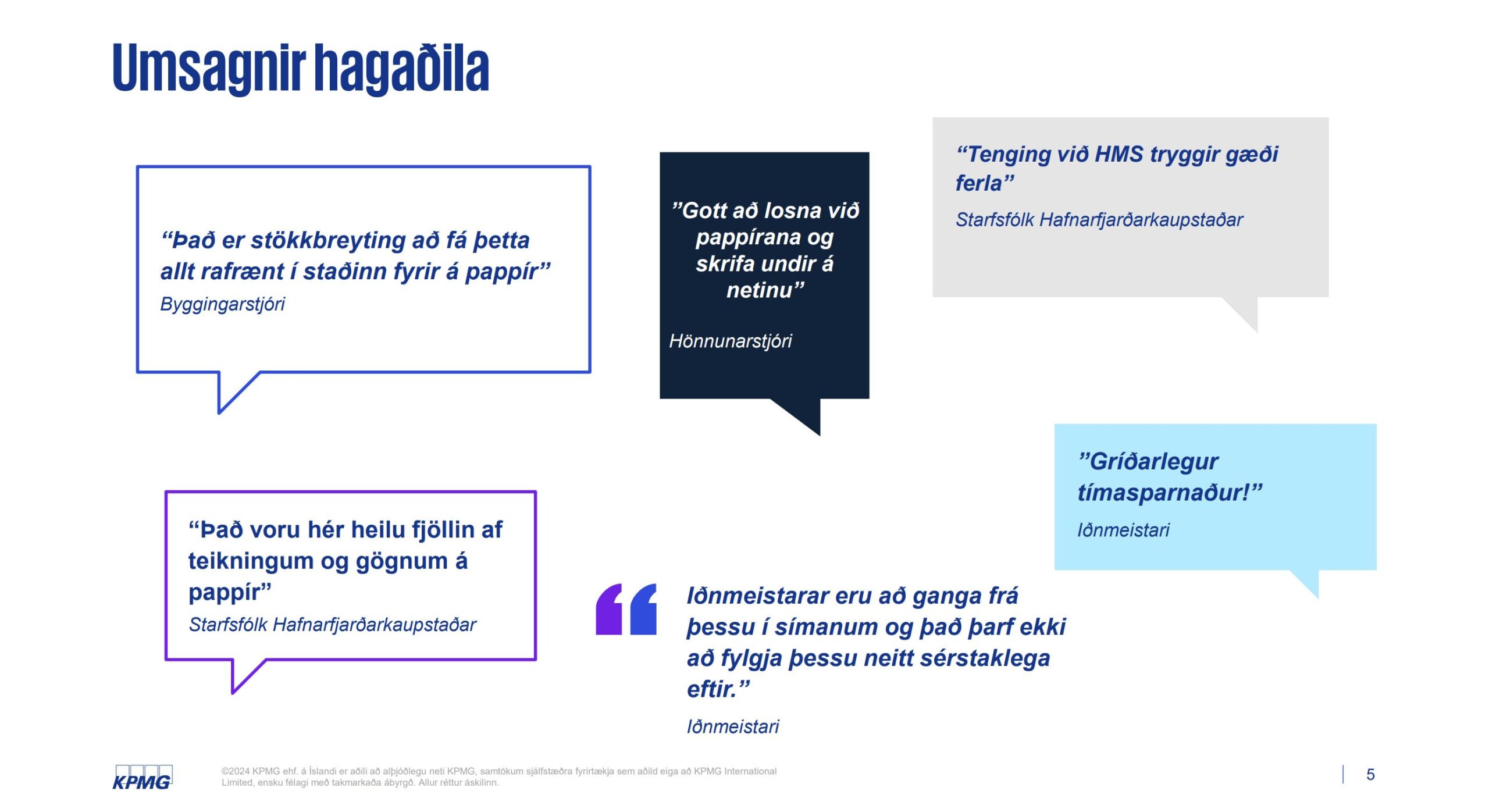
Interviews were also conducted with construction managers and designers to understand the benefits for applicants of digitising the process. Interviews revealed that there were significant benefits for applicants, such as not having to visit the service centre in person to submit documents and meeting all the stakeholders involved in the construction process.
Certain assumptions were used to calculate the annual benefit of digitising the process. Each step was evaluated with the assistance of staff from the City of Hafnarfjörður. The estimated benefit is a conservative estimate, as it does not account for an increase in the number of applications, edge cases, or changes in procedures that could yield even better benefits than those presented in this report.
Of course, we are not stopping here in the digitisation of construction. There are still numerous opportunities for optimisation and efficiency, for example by utilising electronic signatures in internal processes. Feedback from applicants and staff received during the process is an encouragement to continue on this path.
All drawings stored electronically.
Finally, it is worth mentioning that the Municipality of Hafnarfjörður took an important step in digitising drawings and data when it undertook the scanning of all the town's drawings 10 years ago and made them available on a map website that is accessible to everyone. This action was a necessary preparation for the digitisation of building plans, which was then undertaken last year. Previously, drawings were stored in buildings across the town, and staff at the service desk had to run up and down flights of stairs and between buildings to retrieve them. We can thank the foresight of the staff at the time that the situation in Hafnarfjörður is as good as it is.