
The intranet is closing
This summer, Workplace took on a greater role when the council's intranet was closed and its content moved to a new module within Workplace called the Knowledge Library.
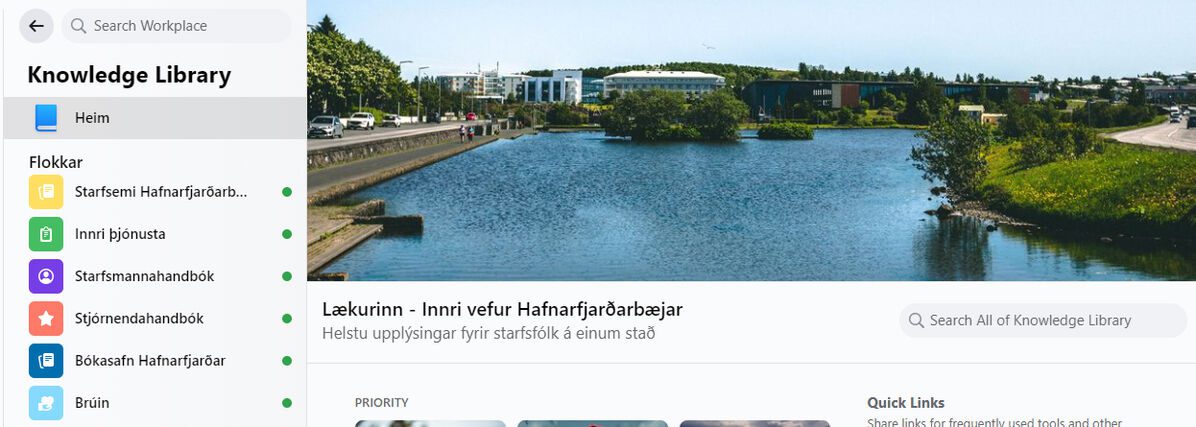
For many years, Hafnarfjörður has had an intranet for its staff, and for the past five years has also used the Facebook communication platform, Workplace, which has significantly strengthened internal information sharing and communication in a workplace of two thousand people. This summer, the platform gained even greater importance when the internal web, Læknum, was closed and its content moved to a new unit within Workplace called the Knowledge Library.
Many webmasters know the good feeling of launching new websites, but there is also a great sense of well-being and satisfaction in closing down websites. A simpler web environment is in everyone's interest.
The intranet had become something of a problem child in recent years. Its usage was declining, and although a new intranet was planned, no solution seemed exciting. With the arrival of Workplace, the intranet became virtually lifeless on the surface. Of course, various practical information such as internal services, the staff handbook and forms were still being maintained, but all information sharing, group work and communication had moved to Workplace and Workplace Chat.
Knowledge Library changed the situation
Just over a year ago, Facebook then released a new feature on Workplace called the Knowledge Library. With this feature, it was finally possible to organise information and manage data in an organised way, by creating categories and sub-pages, or in other words, by managing data in a web tree like on a conventional website.
Since this feature first saw the light of day, Facebook has been continuously developing the Knowledge Library. This quickly convinced us at Hafnarfjörður Municipality that this was finally the opportunity to close down the internal website for good and introduce Workplace and the Knowledge Library as a complete solution for information sharing and staff communication.
The Knowledge Library now contains a wide range of practical resources for staff and managers, such as shortcuts to various systems, information about the council's operations, forms to complete, and a staff handbook with information on staff rights and responsibilities.
The project was organised by a group of digital leaders from all departments. With good information organisation and through powerful search, it is easy to find the material staff need at any given time and to share it with colleagues in chat or groups, which will improve knowledge sharing, save time and enable staff to work together more effectively.
Staff empowerment
As of writing, we have about 2-3 months' experience of this change and we are very pleased with the reception. Few seem to miss the old intranet, and the only complaints we have received are that staff have been having trouble finding HR-related forms, but we chose to move these almost entirely into our HR system, H3, instead of maintaining them in two places. By moving the forms there, a large portion of the information is pre-filled for staff and managers, as the system reads basic information from our core system, Active Directory.
With Knowledge Library, our information managers feel they are in the driver's seat. There is no barrier to learning often complex content management systems, updating content is particularly simple, and the access control is very powerful. We can manage permissions down to individual pages, both for content management and for controlling what each user can see. We now have the option to give individual units or institutions, such as the Hafnarfjörður Library, their own area on the Knowledge Library which only the Library's staff can see. There is a separate area for managers, a separate area for staff working in the Town Hall, and so on.
With the Knowledge Library, we also receive detailed data on staff usage, analysis of whether content is being read, which departments or units are the most active, and which staff members are most active in contributing content.
Use increases significantly
The use of Workplace has increased significantly over the past two years, partly due to Covid, targeted promotion, and encouragement to use the platform. In two years, the number of active users on Workplace has increased by sixty to seventy per cent for the City of Hafnarfjörður, with active users per month now at almost 1,400, compared to around 850 two years ago.
A major advantage of having all internal communication on Workplace is that staff can always access the platform outside the workplace – if they choose to – and have the content on their phone, wherever and whenever. This accessibility has clearly led to increased usage. With the Knowledge Library, Workplace usage is growing even further, and it will be interesting to analyse this in more detail in due course.
It is abundantly clear that Workplace has empowered staff. The old intranet could never give staff or middle managers a voice. With Workplace, everyone can express their opinions. Individual workplaces can work more closely together and in cross-functional teams. And with the Knowledge Library, individual units, departments and institutions are now in the driving seat of their information sharing and communication.
We still have a way to go to reach an even larger group. We hold presentations, publish posters, attend staff meetings and regularly send out encouragement to staff and managers to use the platform. The project is therefore not yet complete, but we are convinced that Workplace, and now the Knowledge Library, will serve the staff of Hafnarfjörður well for years to come.