
The children drew and expressed how they felt.
The lockdown that came into effect here on 16 March had a wide-ranging impact on the City of Hafnarfjörður as a workplace. In a very short space of time, the city's institutions had to be mobilised to adopt a new way of thinking and to organise the work of each workplace in line with the recommendations of the civil defence authorities.
The lockdown that came into effect here on 16 March had a wide-ranging impact on the City of Hafnarfjörður as a workplace, and in a very short space of time it was necessary to mobilise the city's institutions towards a new way of thinking and to organise the work of each workplace in line with the instructions of the civil defence authorities. There are 18 nurseries in Hafnarfjörður. Guðbjörg Hjaltadóttir, headteacher of Hraunvallar nursery, says the situation ultimately brought people closer together.
The town newspaper Hafnfirðingur I spoke with Gudbjörg the other day.
All the work of the nurseries had to be reorganised from scratch after the meeting of all nursery heads on 15 March, where the groundwork was laid. „Fewer children than usual were allowed to attend, and teachers were allowed to come in every other day, in two groups. We grouped together children in each group who were friends and siblings, and nursery teachers who had children at other nurseries were even asked to work there for a while.“ says Gudbjorg. Two to three teachers were on each unit with 9-12 children. The outdoor area was divided up and there were no communal coffee breaks for staff. „All touchpoints had to be disinfected and the two-metre rule observed. Parents were not allowed onto the nursery premises but collected and dropped off the children at the coat rack at the front. „The parents were wonderful and positive and everyone was somehow united in making it work. Then we had wax crayons and felt-tips for each group and had to take out of circulation all the wooden toys, jigsaws, beads and things like that which couldn't be cleaned properly.

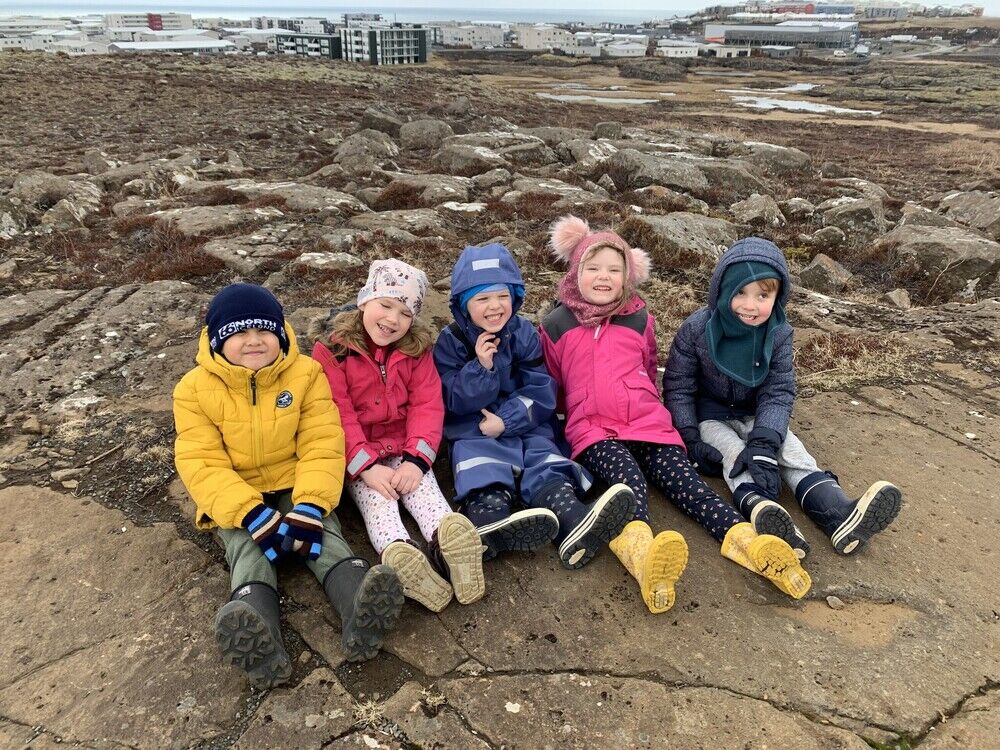
Pupils at Hraunvallar leikskóli are keen to make use of the surrounding nature for outdoor activities. Photo/submitted

One of the wish flowers that were drawn. Photo/submitted
The children were poorly informed.
Asked about the children's reaction to the change in the lockdown arrangements, Guðbjörg says that some of them were incredibly well-informed, while others weren't paying any attention to the commotion. „One girl asked for gloves, a letter and a spray can when she arrived and went straight to sanitising. Children drew the coronavirus as they imagined it and as it was commonly portrayed in the media. Some drew the virus in their hearts and described how they felt, that it wasn't nice to get a crown in you and that it was boring that everything was closed because of the coronavirus, and one six-year-old was sad that nobody was coming to visit. The children are so good at reflecting everything in their play straight away,“ says Gudbjorg.


 Drawings of the coronavirus by the children. The coronavirus through the eyes of children. Photo/submitted
Only two children went into quarantine
Of 72 children at Hraunvallar nursery, only 2 had to go into quarantine and none of the 25 staff members contracted COVID-19. Gudbjörg says the lockdown brought the nursery staff closer together. „We became even more cohesive and have also learnt how good it is to have a job and job security. I'll admit I felt a bit lonely in my job because I wasn't seeing as many people; parents and children. I was mostly in the preparation room and would only see my own group every other day, observing the 2-metre rule. So, it was a great day of joy for me on the 4th of May when the lockdown was lifted. The staff were also absolutely terrified of the situation, like many people, and nobody wanted to infect or be infected. The fear was certainly a source of stress, and you just had to take it one day at a time. Looking at covid.is daily felt like I was checking my exam results on how well I was doing at keeping the virus in check.“ says Guðbjörg, adding in response to a final question that this period has, among other things, taught many people to use video-conferencing equipment more, as it made meetings more focused. „There is always a way out of everything, even if it feels overwhelming while it's happening. I'm pleased with how the City of Hafnarfjörður handled this, and I'm proud of my staff.“
An interview with Gudbjorg was published in Hafnfirðinginn on 20 May 2020.
Cover photo of Guðbjörg with students: Front row: Eygló Þurý, Sara Dís, Emilía Ósk, Auður, Guðbjörg, Heiðbjört Halla and Emelía Sól. (Photo/OBÞ)