
Energy transition in the Port of Hafnarfjörður
Hafnarfjörður Harbour is the first port in Iceland to offer its clients access to powerful shore power, where ships can receive power of up to 1.2 MW. With these new shore connections, vessels can receive electricity that is compatible with their onboard electrical system, i.e. 400, 440 or 690 Volts at 50 or 60 Hz.
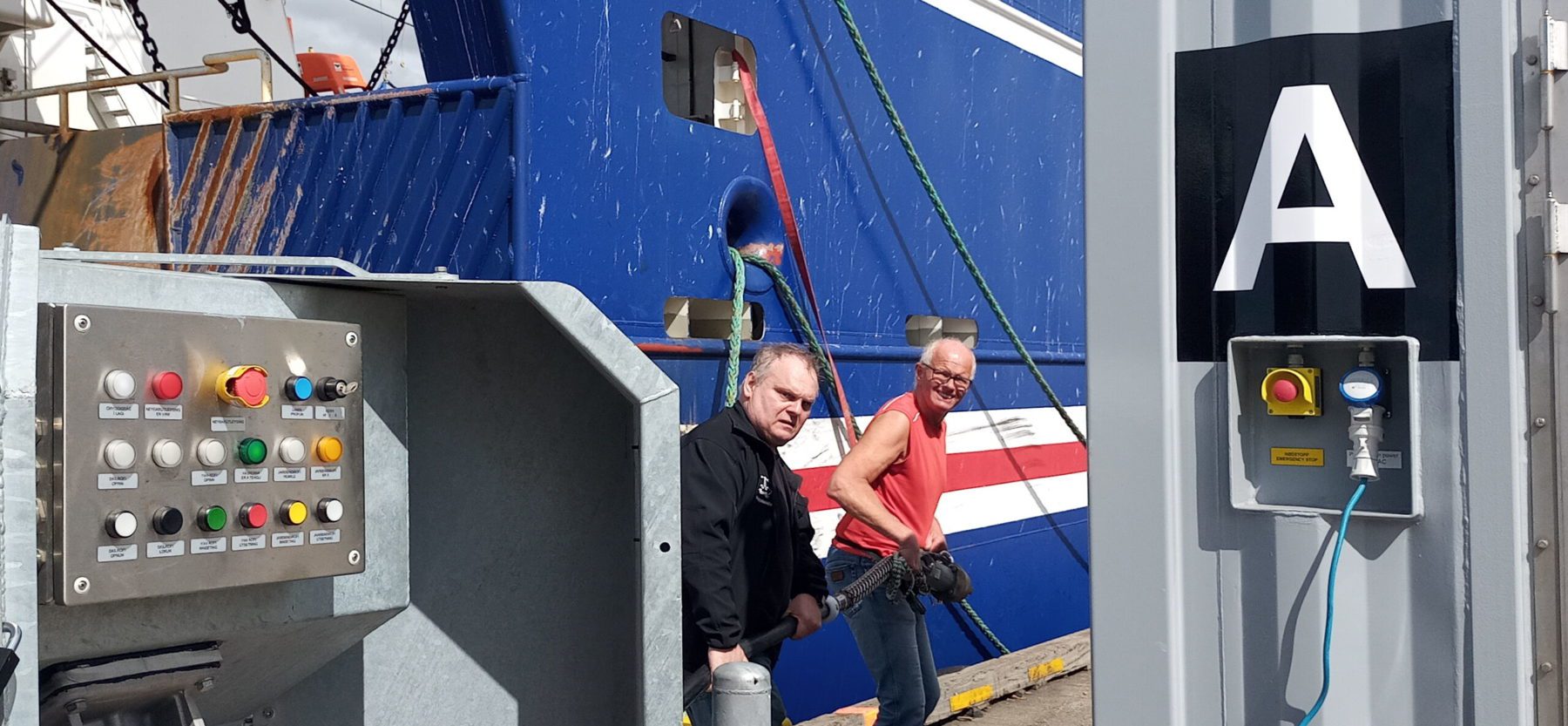
High-capacity land connections taken into
use at the harbour of Hafnarfjörður
Hafnarfjörður Harbour is the first port in Iceland to offer customers
to connect to powerful electrical land connections where ships can get all their power
to 1.2 MW. With these new shore connections, ships can receive electricity that is in accordance with
the ship's electrical system, i.e. 400, 440
or 690 Volts at 50 or 60 hertz. The first connection is scheduled for Friday, 10 June, when the freezer trawler
Baldvin Njálsson GK 400 is connected to 440 volts on 60-amp sockets. The passenger ship Le Bellot, owned by the French company Le Ponant, arrives.
by connecting to a new system on Seamen's Day, 12th June this year. It is the first
a change involving the ship being connected to shore power, and also the first time as a passenger ship
is connected to the mainland here.
 High-voltage connections at Hvaleyrarbakka. Baldvin connected, cable on board.
Widespread environmental impact
By docking, ships do not need to burn fossil fuels.
at the quay, but it is estimated that around 14 % of a ship's fuel consumption occurs while moored. It is clear that, in general, ships are not yet shore-power-ready. The cost of making them so
The connection speed isn't very high, and hopefully, that will change a lot here.,
especially when conditions in ports generally allow ships to connect
electricity that suits them.
This summer, the passenger ship Le Bellot is expected to call at the Port of Hafnarfjörður around 10 times.
It is estimated that the ship requires about 600 kW, which amounts to around 20,000 kWh per stay.
By using earthed electrical power, greenhouse pollution is reduced at each
Le Bellot's inventory of approximately 14,000 kg of carbon dioxide or CO2,
i.e. 14 tonnes. Based on 10 indoor events over the summer, the pollution is therefore reduced by 140.
tonnes of CO22. This also has a significant impact on air quality, as neither
becomes nitrogen oxide, NOx, nor fixed PM particulate matter10
or PM2,5 nor any SO soot particlesx. Also, you can have in
Bear in mind that a shore connection significantly reduces noise from ships.
The technology behind these powerful landlines
The technology behind these powerful land connections is based on having
a high-voltage connector on the ship's side, to which a voltage device is then connected where
it is possible to control whether the voltage is 400, 440 or 690 Volts and whether the frequency is
50 or 60 rows. Two high-voltage connections are in Hafnarfjörður harbour, one at Hvaleyrarbakki and
another on the South Bank. The voltage and frequency equipment is in specially-equipped mobile containers,
two 10-foot and one 20-foot. To
Electric Zinus-type capstan winches are used to bring the power on board.
which each electrical cable can carry 350 amps.
The implementation is twofold.
The implementation of the project was twofold: on the one hand, the high-voltage part, and on the other hand
low-voltage section. Following a tender for the high-voltage section, an agreement was made with the company Orkuvirki, which was responsible for
Construction works on the installation at Hvaleyrarbakka and Suðurbakka. Design of
The high-voltage section was in the hands of Jón Björns Bragason, B.Sc., Electrical Engineer.,
MBA. The low-voltage equipment was tendered as a lump sum, based on the specified requirements.
Ríkiskaup managed the tender in accordance with the specification from J2B Consulting and Sætækni.
The Norwegian company PSW Power and Automation had the lowest bid and was awarded the contract.
with that.
Environmental policy
Hafnarfjörður Harbour
The start of this project is the harbour board's approval of an environmental policy and
action plan for the harbour by the end of 2019, but preparation of the design and
implementation began in May 2020. The project
has thus taken two years from when preparations began to the completion of the work. The land connection now is the first phase in a larger project which includes further
construction of land connections in Hafnarfjörður harbour and also in Straumsvík. Estimated
the total cost will be around 600 million króna but the cost of this first
The cost of the phase amounts to approximately 240 million króna. The project management, on behalf of Hafnarfjörður Harbour, was handled by Sætækni ehf, Gunnar.
Hörður Sæmundsson, Mechanical Engineer in the Energy Division, B.Sc., MBA, and supervision by
The Port of Hafnarfjörður was in the hands of harbourmaster Ludvik Geirsson and Arnar
Chief Engineer Olafsson.