
Among other things, he registered his great-grandmother's home.
We are all familiar with the natural splendour of the Hafnarfjörður countryside. In this area, which is largely covered by lava fields, lie ancient monuments that are more or less conspicuous, but all of which are remarkable and connected to the town's history. For many years, the Hafnarfjörður Folk Museum has been cataloguing and mapping ancient monuments in the town, defined as being 100 years old or older.
We are all familiar with the natural splendour of the Hafnarfjörður countryside. In this area, which is largely covered by lava fields, lie ancient monuments that are more or less conspicuous, but all of which are remarkable and connected to the town's history. For many years, the Hafnarfjörður Folk Museum has been cataloguing and mapping ancient monuments in the town, defined as being 100 years old or older. The town newspaper Hafnfirðingur He spoke with the archaeologist Atli Rúnarsson, who has been working on this mapping for the museum since last August.
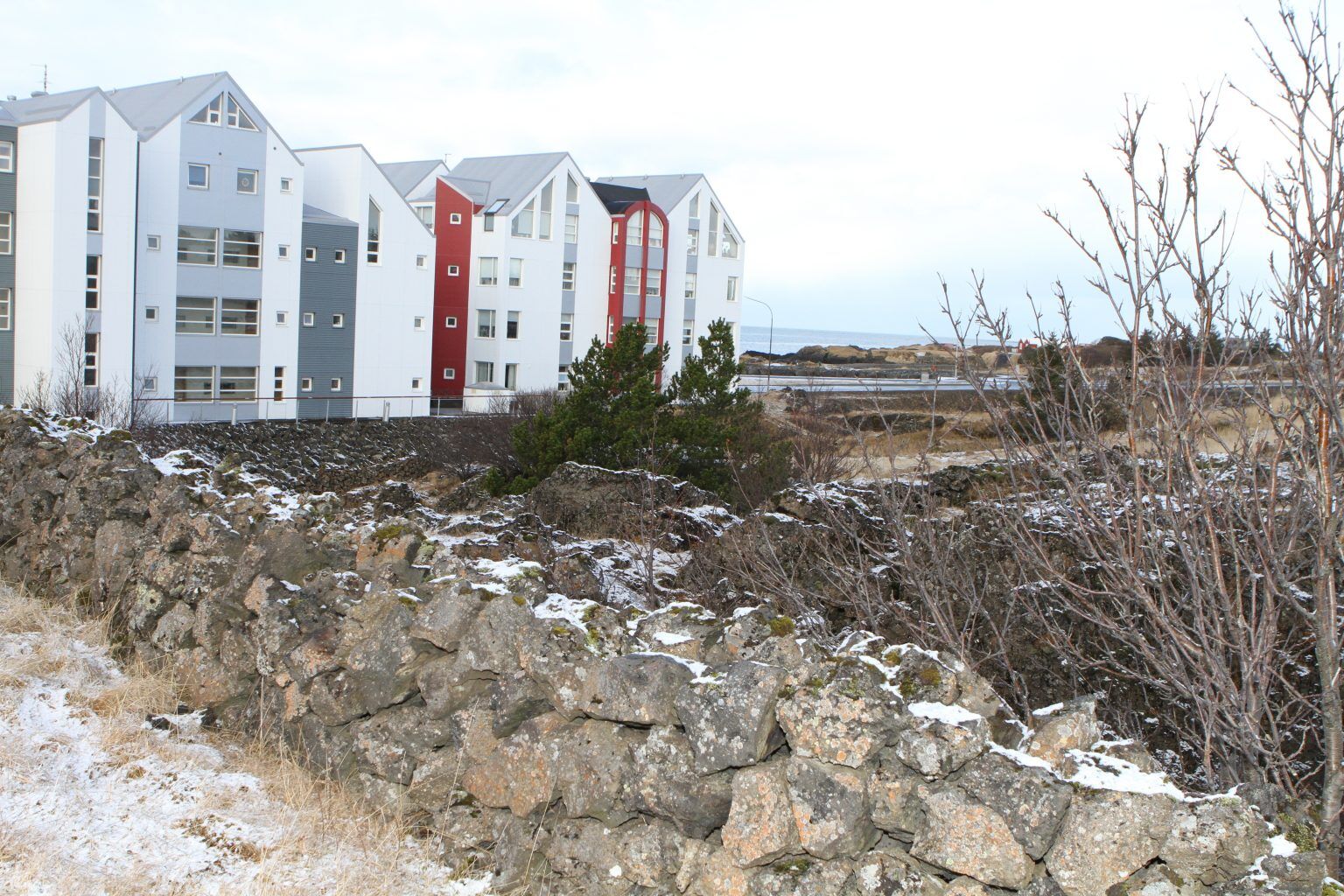
 The back garden of Herjólfsgata 38 and 40 is remarkable. Photo/OBÞ
Behind 38 and 40 Herjólfsgata stood the farm Eyrarhraun, which was built in 1904 and burnt to the ground following an arson attack in 2005, after having stood empty for a year. Eyrarhraun had great cultural and historical significance and was home for a time to Stefán Júlíusson, the author of the books about Kári litli and Lappi. He has also written the history of the outlying farms in the area. Today, only the foundation of the house where it stood can be seen, but beside it is a buried storage shed and, a short distance away, a beautifully built field wall and land boundaries.
Using, among other things, drones, 3D models and a thermal camera.
„I am working on a comprehensive archaeological inventory for the municipality, which is part of the town's main plan. Archaeological recording is essentially the mapping of ancient monuments and is a vital part of protecting our cultural heritage, as we cannot protect what we do not know about. Archaeological recording is also essential for planning purposes and, according to the Cultural Heritage Act, an archaeological survey must be carried out before local plans are approved.“ says Atli. Before actual on-site archaeological recording takes place, sources on the settlement of the area being recorded are consulted, e.g. county and parish descriptions, old maps and place-name records. Then the site is visited with a GPS device and precise measurements of the remains are made.
„Then there's also the constant technological development in this, as in everything else. People have been experimenting with detailed 3D models made with drones and thermal cameras. But it's a question how well that would work in the lava field here in Hafnarfjörður; it would still be interesting to try it, though.“
 Ancient monuments at Thorbjarnarstaðir, Straumsvík.
Will be available on the town's map website
Atli says that Eyrarhraun is just one example of the many relics that have been found in the townlands of Hafnarfjörður.„A lot had been recorded before I started, but the recording standards were updated in 2012 and have become more detailed. As a result, many of the older records had become outdated and had to be re-recorded. The earlier surveys were carried out here and there around the town in connection with local plans, but we are now approaching the project in a very systematic way. We have divided the town into twelve areas and are working our way through them. I am putting the finishing touches to the seventh area, which is Setbergið. There are now around 750 registered monuments, and most of them are in the older part of the town and on the old farms around the town which have for the most part been left untouched, such as at Óttarsstaðir, Lónakot and Þorbjarnarstaðir. I then write a report on each area, which includes a brief historical overview, the earliest records and so on, and it contains a list of the archaeological sites in the area. These are publications that can be enjoyable to browse through, and people can find accessible information about the heritage in their local area.“ When asked, Atli says that all the records will eventually be published on the National Heritage Institute of Iceland's Heritage Map Viewer and the City of Hafnarfjörður's Map Portal. The reports will be available on the museum's website: www.byggdasafnid.is

A storage shed that was by the farm Eyrarhraun, which is mentioned at the beginning of the interview. Photo/OBÞ
Lucky to work in a field you are passionate about.
The oldest known farmstead in Hafnarfjörður is Hvaleyri, where, during construction work, remains from the settlement period were found, including a charcoal pit dating from around the year 900. „More recent monuments include the fish-ponds and stone walls in the village. Most of the monuments are built from the lava rock from the lava field, as there is plenty of it.“ says Atli. When asked, he says that nothing has really come as a surprise in this work, as he is a trained archaeologist and this fascinating discipline involves a great deal of fieldwork. „I feel that first and foremost, I'm lucky to be able to work in a field I'm passionate about. It's rewarding to be able not only to document the town's heritage and historical sites but also to make this information accessible to everyone who is interested. I also feel a special connection to this project, as my great-grandmother, Elín Friðfinnsdóttir, grew up on the farm Óttarsstaðir, which is in fact one of the places I have documented.“
Asked finally whether it is likely that more ancient monuments could be found in Hafnarfjörður that were not previously known about, Atli says: “During an archaeological survey, something “new” is always found, but the recording only covers what is visible on the surface and what is documented is by no means exhaustive. Some remains are such that it matters what time of year you visit, and there can always be all sorts of things hidden under the snow, too.“
 Loads like these, made from lava, are common in Hafnarfjörður. Photo/OBÞ