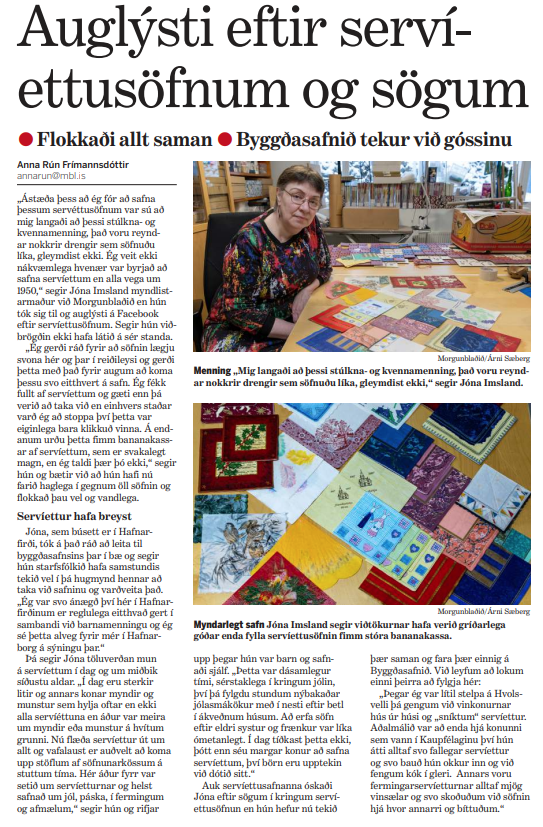
The Folk Museum preserves visions of the future.
„When we receive such items, we always consider whether they have exhibition value. The napkin collection from Jóna Imsland certainly has that,“ says Björn Pétursson, the Hafnarfjörður town antiquarian. The museum recently acquired a napkin collection in five large banana boxes. The artist Jóna Imsland offered the collection to the museum.
Culture is flourishing in Hafnarfjörður. The story is told at the Folk Museum.
„When we receive items like these, we always consider whether they have display value. The serviette collection from Jóna Imsland certainly does,“ says Björn Pétursson, the Hafnarfjörður town curator.
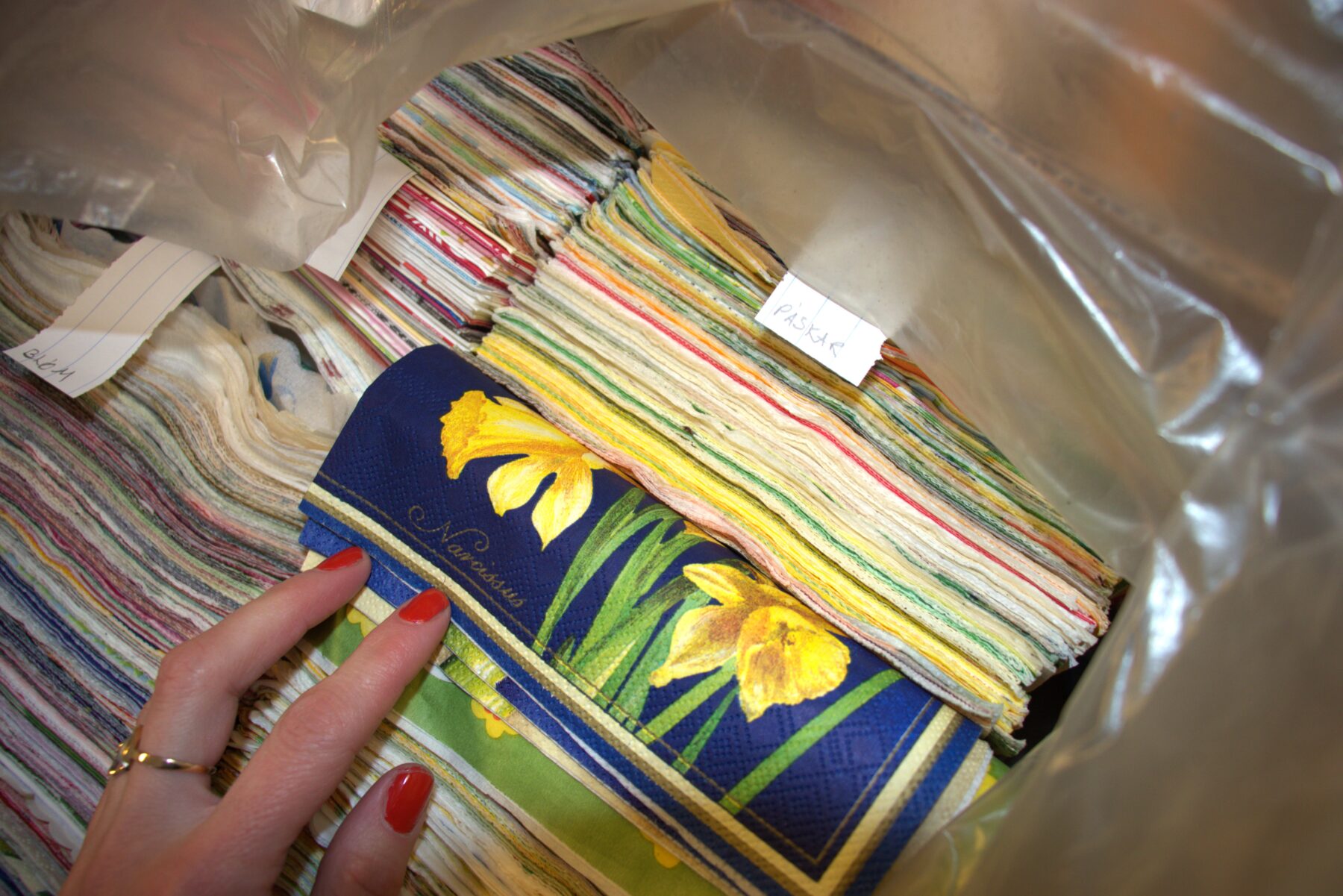
The museum recently acquired a collection of napkins in five large banana boxes. The artist Jóna Imsland gave the collection to the museum. She says she began collecting these serviette collections from women who had previously gathered them, to ensure that this culture, which had mainly flourished among girls and women, would not be forgotten. She then combined all the serviette collections into one and collected stories about them.
To keep the memory alive
„I have no idea how ideas come to me. They just appear,“ says Jóna cheerfully when asked how the idea came about. But the purpose is to keep alive the memory of this girl culture that was — and of the women who are now fully grown adults and are still collecting. She is delighted that Björn was so receptive to her request and saw the collector's value in the napkins.
„I was so pleased with how well he took it, that he agreed to this. When I posted about it on Facebook and asked for stories, so many people commented on how wonderful it was that the collection was willing to take it. Not all museums see it as anything; just some girls collecting napkins.“
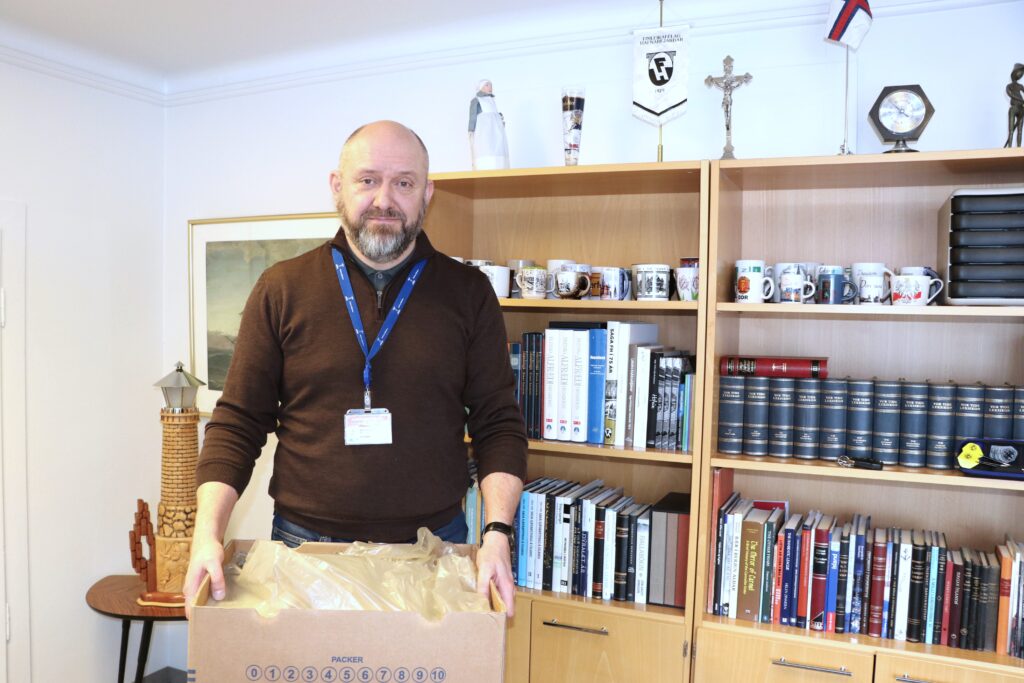
Björn Pétursson, the town curator of Hafnarfjörður, with one of five boxes packed full of napkins that Jóna Imsland collected and gave to the Hafnarfjörður Folk Museum.
A large collection of decorated stories
Björn says that what makes the serviette collection so exciting is its sheer size, but not least because Jóna collected the stories of the women who owned and collected them as girls. „This is heritage preservation and folklore. This custom was widespread at one time, and it is our duty to preserve that culture and history.“
But where does this tradition come from? „It has spread, someone took it up just as people collected action figures to swap. It's part of people's collecting culture,“ says Björn, adding that the museum often receives donations.
„Yes, we're offered quite a lot of artefacts, but we say no if we already have them and follow our collection policy,“ he says, smiling. „All our collection has come through donations. We don't buy any artefacts; rather, the goodwill of the community forms the collection, and has done for seventy years.“
Jóna describes this tradition which is slowly but surely disappearing. „The napkins are something incredibly beautiful, that you can stroke, look at, and rearrange. It was the fashion of the time. This kind of culture is forgotten. Many have let their grandchildren play with their collection, but many collections have also ended up in the bin like other bits of paper.“
The stories are still coming in
Björn says it is unlikely that such a comprehensive napkin collection could be found elsewhere in the country. „There are plenty of napkin collections, but I've never heard of a quantity like this. Five of these banana boxes. This is now one large collection made up of many collections. The stories are still coming to light,“ he says, describing how Jóna took on the collections and sorted them into her own collection.
Jóna has her own napkin collection. It is kept in iron boxes in a cupboard in her house in Höfn in Hornafjörður, where she grew up, although she has lived in Hafnarfjörður for the last thirty years. „Yes, they're waiting in the east, unclassified,“ she says, and she hasn't stopped collecting stories, even though she has handed the napkins over to the Hafnarfjörður Folk Museum.
So how are the napkins stored for the future? „We have very good storage facilities; we monitor temperature and humidity,“ says Björn. „We have strict oversight from the collections committee regarding how we handle the items. They will be preserved for posterity.“
A napkin story that now lives at the Hafnarfjörður Folk Museum:
Wonderful. I still have one napkin from my confirmation, which was in 1971, and I've had it framed, so it's well-kept. I can certainly put my story here:
„I first became interested in napkin collecting in Northfjord, where I was born and lived until the age of 9, the thing was that all napkins were very precious because there were few of them and they were therefore saved and reused on every occasion, and we also made dresses for dolls and all sorts of decorations out of them; nothing was thrown away in those days.
I started collecting napkins when I was young, and my friend and I would go from house to house asking for them. We were always very well received and would sometimes get one or two. I had a lovely box that was the packaging for a nightdress Mum had received as a Christmas present from Dad one Christmas, it was gold-coloured with a sort of see-through plastic lid, and that's where the napkins got to live. I really admired them and would often line them up, making sure to smooth them out properly. But the most fun was always going to the grown-up lady who lived next door to us, she always invited us in for cocoa and sweet breads, and we got to drink from beautiful mugs and of course, there were napkins. Today, these memories are precious to me, and I always take good care of my napkins; they have their own drawer in my sideboard.“ Kind regards.
The Morgunblaðið reported on Jóna's collection the other day: