
Local authorities and the government update the transport agreement
„It is pleasing that we in Hafnarfjörður can now look forward to significantly more funding being put into solving the main traffic bottlenecks in the town on the Reykjanesbraut from Lækjargata to Kaplakriki/Álftanesvegur,“ says Mayor Rósa Guðbjartsdóttir, who signed the updated transport agreement on behalf of the City of Hafnarfjörður yesterday, along with five other municipalities and the state.
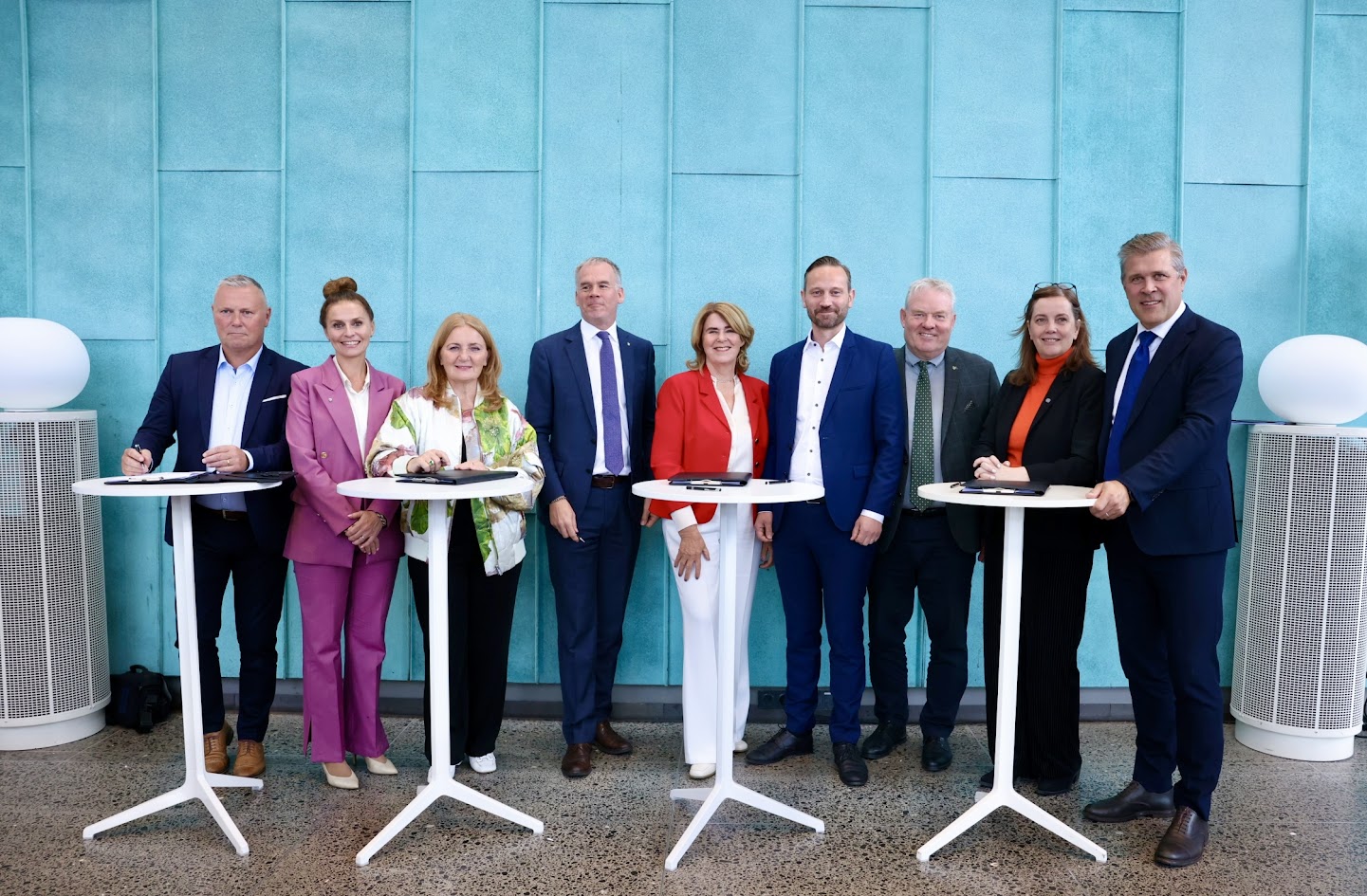
Newly updated transport agreement!
- Improved quality of life, smoother traffic and shorter travel times for all modes of transport.
- Significant social benefit and increased traffic safety
- Public transport significantly enhanced with increased state support
Shorter journey times, fewer delays, improved traffic safety, a focus on reducing the carbon footprint, greatly improved public transport, an increase in cycle and walking paths and the development of major roads are at the core of the updated transport agreement for the capital region, which was signed yesterday.
Mayor Rósa Guðbjartsdóttir signed the agreement on behalf of the City of Hafnarfjörður. „At last, there is a plan for the future development of transport infrastructure in the capital region, which has been long overdue. Tens of thousands of vehicles use the roads here every day, and it has long been clear that serious action must be taken to ensure smoother traffic flow and increase safety,“ she says.
„It is pleasing that we in Hafnarfjörður can now look forward to significantly more funding being invested in solving the main traffic bottlenecks in the town on the Reykjanesbraut, from Lækjargata to Kaplakriki/Álftanesvegur. The design and preparation for this important project will begin as early as next year.“
A shared vision for the capital region
The agreement includes a shared vision for the entire capital region, where the main emphasis will be on the efficient and cost-effective development of transport infrastructure. The aim is for transport in the capital region to be of the highest standard, ensuring the region and Iceland as a whole are competitive for both people and businesses.
The state and six municipalities in the capital region, Garðabær, Hafnarfjörður, Kópavogur, Mosfellsbær, Reykjavík and Seltjarnarnes, have reached an agreement on an updated charter which includes the development of transport infrastructure and public transport in the area until 2040.
At the same time, an agreement was signed on cooperation regarding the operation and governance of public transport in the capital region. The aim is to enhance public transport, including through increased state support, and a joint company will be established for its planning and operation.
A realistic plan for 2040
The contract was updated last year due to increased scope and significant general cost increases. Cost estimates have been revised in light of experience, and many projects are now closer to the implementation phase. The agreement's validity has been extended to 2040 to ensure a realistic timeframe for preparation and funding.
Cost-effectiveness and social benefits
An independent analysis of the societal benefits of the transport agreement projects (Cowi 2024) indicates significant benefits from shorter and more reliable travel times and reduced traffic delays. The total investment of the Transport Agreement amounts to 311 billion kr. The benefits are estimated at 1,140 billion kr. over 50 years, with an internal rate of return of 9.21% and a benefit-cost ratio of around 3.5. This means that for every króna invested in the project, the society receives three krónur back.
Increased choice in transport is a key factor in the analysis, as more people would be able to use public transport, leading to a reduction in traffic congestion and pollution, as well as lower running costs for households.
Arterial roads, public transport, cycle and pedestrian paths, and smarter traffic management
All the key projects are the same as before in the transport agreement, but changes are being made to individual projects.
The total investment in the first period of the updated transport agreement, until 2029, averages just over 14 billion króna per year. That is equivalent to a third of annual transport investment in the budget. In the period 2030-2040, total investment averages 19 billion króna per year. Total investment to 2040 is estimated at 311 billion króna.
The projects of the Transport Agreement are divided into four main categories: Trunk roads, the City Line and bus routes, pedestrian and cycle paths, and projects related to traffic management, flow and safety. The following is a more detailed description of the project categories and their share in the transport agreement:
- Trunk roads – 42%. Six major trunk road projects will be undertaken in the capital region, in addition to the three already completed under the agreement (the trunk road projects on Suðurlandsvegur, Vesturlandsvegur and Reykjanesbraut).
- Metro and bus routes – 42%. Public transport will be greatly improved with the construction of the Metro in six phases. Services for residents will be continuously improved through an integrated network of bus and Metro routes.
- Cycle and walking paths – 13%. Cycle and walking paths will be increased and significantly improved in the updated charter, with around 80 km of new paths to be laid in addition to the 20 km already laid under the charter.
- Traffic management, traffic flow and safety measures – 3%. Investment will continue in new technology and equipment to improve traffic flow and safety on major roads.
Motorway in tunnels and new junction of the Reykjanesbraut and Bústaðavegur
The biggest changes to individual projects from the previous transport agreement are that the Miklabraut will be put into a tunnel for about 2,8 km of underground tunnels with connecting tunnels at Kringlumýrarbraut, replacing the 1.8 km Miklabraut viaduct, and Sæbraut will be placed in a tunnel instead of the previous plan for a single-level junction. Additionally, the new junction of Reykjanesbraut and Bústaðavegur has been designed with free-flowing traffic, as well as a dedicated lane for the Borgarlína to connect Mjódd to the public transport network. Finally, the works on the Suðurlandsveg between Norðlingavæði and Bæjarháls are being transferred to the transport plan. Options that lead to increased efficiency and traffic safety are continuously evaluated.
Increased contribution to the financial plan
The division of funding between the state and local authorities will remain the same as before, with local authorities receiving 12.51% and the state 87.51%.
The government's direct contribution to the transport agreement will be kr. 2.8 billion per year from 2024 until 2040. In addition, an annual additional contribution of kr. 4 billion is planned. kr. in the newly approved state budget from 2025 to 2029. In addition, increased proceeds from the development and sale of the Keldnaland site, which the state contributed to the project upon signing the transport agreement in 2019, are also anticipated.
The direct contribution from the municipalities will be 1.4 billion króna per year from 2024 until the end of 2040. In addition, an annual supplementary contribution of 555 million króna will be added to the direct contributions from the municipalities from 2025 onwards. Municipalities in the capital region share the cost each year based on their respective population share on 1 December of the previous year.
From 2030, revenue is expected to come from traffic or other government funding. The government is working on a new approach to funding the road network, which will be introduced in stages over the coming years. The aim is to adapt the funding system to the energy transition and the declining use of fossil fuels, with charging based on usage instead of specific taxes such as oil and petrol duties. The first steps have already been taken with the introduction of a kilometre charge for electric cars, which previously paid very little for their use of the road network.
Joint Association for Major Improvements to Public Transport
The State and the local authorities signed an agreement on cooperation regarding the operation and governance of public transport in the capital region. The agreement includes increased financial support from the state and a more active involvement in governance. The state will cover one-third of operating costs, after deducting passenger revenue, in partnership with the municipalities. The state will also provide funding for the transition to clean energy in public transport.
The division of funding between the state and local authorities will remain the same as before, i.e. local authorities will receive 12.51% and the state 87.51%.
The government's direct contribution to the transport agreement will be kr. 2.8 billion per year from 2024 until 2040. In addition, an annual additional contribution of kr. 4 billion is planned. kr. in the newly approved state budget from 2025 to 2029. In addition, increased proceeds from the development and sale of the Keldnaland site, which the state contributed to the project upon signing the transport agreement in 2019, are also anticipated.
The direct contribution from the municipalities will be 1.4 billion króna per year from 2024 until the end of 2040. In addition, an annual supplementary contribution of 555 million króna will be added to the direct contributions from the municipalities from 2025 onwards. Municipalities in the capital region share the cost each year based on their respective population share on 1 December of the previous year.
From 2030, revenue is expected to come from traffic or other government funding. The government is working on a new approach to funding the road network, which will be introduced in stages over the coming years. The aim is to adapt the funding system to the energy transition and the declining use of fossil fuels, with charging based on usage instead of specific taxes such as oil and petrol duties. The first steps have already been taken with the introduction of a kilometre charge for electric cars, which previously paid very little for their use of the road network.
Joint Association for Major Improvements to Public Transport
The agreement involves the local authorities and the state establishing a joint company that will be responsible for the planning and operation of public transport in the capital region. The new company's operations will cover both conventional bus routes and the Metro. The company is set to begin operations around the turn of the year.
Public transport services will be significantly improved until the new network with the City Line is fully implemented. With the new network and the City Line, the aim is for seven out of ten residents to be within walking distance (400 m from a stop) of high-quality public transport that runs every seven to ten minutes. Improved public transport is key to improving residents' quality of life, reducing their transport costs, improving traffic flow and reducing pollution.
About the work of the dialogue group
The dialogue group of the government and local authorities began the update of the Transport Agreement in March 2023. The negotiating group was tasked, among other things, with updating the transport agreement and implementation plan, carrying out an impact assessment of the agreement's portfolio of projects, and drafting an agreement on the strengthening of public transport to ensure its operation in the capital region.
The government and local authorities' dialogue group invited a number of stakeholders to attend its meetings, in addition to extensive cooperation with Better Transport and the National Road Administration. Ragnhildur Hjaltadóttir, Chair of Better Transport, chaired the dialogue group.
The news is based on text that appeared on website of the Ministry of the Interior. Further information can be found there.