
Wants to create opportunities for as many people as possible
The Faculty of Engineering at the University of Iceland has been based on the 3rd floor of the Menntasetrið við Lækinn since September 2018. At that time, there were seven first-year students, but this year that number has grown to 23. The student body is diverse and comes from all over, thanks to the centre's convenient location. The average age of students is now over 30, many with families and even working alongside their studies.
The Faculty of Engineering at the University of Iceland has been based on the 3rd floor of the Menntasetrið við Lækinn since September 2018. At that time, there were seven first-year students, but this year that number has grown to 23. The student body is diverse and comes from all over, thanks to the centre's convenient location. The average age of students is now over 30, many with families and even working alongside their studies.
The town newspaper Hafnfirðingur He spoke with the director, Karl Sölvi Guðmundsson, an associate professor at the Faculty of Electrical and Computer Engineering at the University of Iceland. He is convinced that Hafnarfjörður can become a thriving university town and that this will, for example, have a positive effect on the town's retail and service sector.
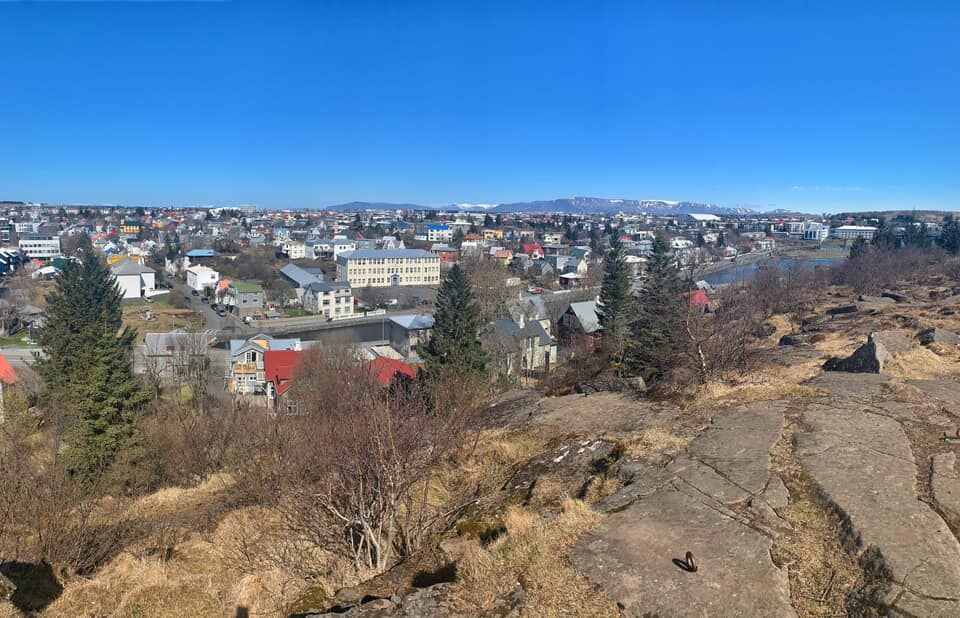
 The Learning Centre by the Stream (centre of the picture), seen from the Cliffs. Photo/OBÞ
The engineering programme run by the University of Iceland originally began in 2009 at Keilir, and in 2022 the 10th graduating class will graduate. Technology Engineering is a practical, 210-credit BSc degree programme that qualifies students to apply for the protected professional title of Technologist. During the programme, students acquire strong technical knowledge alongside the skills to apply it to real-world projects related to industry. Karl says that students have diverse backgrounds. For example, many have completed a vocational training course but not a sixth-form education.
 Student Áslaug is working on a project in Flétturásir. Photo: Kristinn Ingvarsson
 Photo/Kristinn Ingvarsson.
„We try to structure the course so that students who have completed their secondary school education can begin a degree in engineering. It is unfair to expect that primary school pupils know exactly what they want to study and do for the next 60 years when they choose their secondary school course. As people mature and gain life experience, their attitudes and interests change, and the education system must provide opportunities for them to change their minds and take a new direction in life. We try to create this opportunity for those who want to pursue a degree in engineering science.“
 Student Einar is working on a project to produce organic diesel fuel. Photo: Kristinn Ingvarsson.
Students bring the city centre to life
The facilities for the engineering studies at the centre are limited, but the course has now been reasonably well established, and Karl says the environment is exciting for the students. „Hafnarfjörður is an ideal location for higher education; there are many restaurants within walking distance, and students and staff bring the town to life. Today, around 70 people from the facility come to get services and buy something to eat here in Hafnarfjörður town centre every day. That must be good for the local community.“

„Hafnarfjörður is an ideal location for higher education; there are many restaurants within walking distance, and the students and staff bring the town to life,“ says Karl. Photo/OBÞ
Next year, the number of students will increase by 30 to 40, and then there will be 100 people strolling around the town centre, feeding themselves and supporting other shops and services. „The collaboration with the City of Hafnarfjörður has been very good. This autumn, with 27 registered new students, we were facing having to teach their courses in two groups due to distancing requirements, but then the city gave us the use of the room here on the second floor, which can accommodate up to 50 students. We feel very supported by the council. If attendance continues to increase, we will either have to introduce enrolment limits or get the floor below us next year.“
 A laboratory in chemical and biotechnology. Photo/OBÞ
 Robotics studio, final project „sign language glove“. Photo/OBÞ
Personal service and a close relationship
At the Faculty of Engineering, there are two degree programmes leading to a BSc. They are Mechatronics Engineering, an interdisciplinary programme with a focus on mechanical, computer and electrical engineering, and Production Engineering, where the focus is on production processes in chemical and biochemical engineering. In addition, there are five short 90 ECTS diploma programmes which are fully credited towards the respective Bachelor's degree. Good information, pictures and videos about the courses can be found on the website. http://fag.hi.is

Mechatronics Lab, final project, „the scrubbing slave“ Therrari. Photo/OBÞ
„We try to create a learning and working environment where everyone feels comfortable. Our student service is personal and we offer a close-knit community. Our courses are small compared to many others at the University of Iceland. Many students simply don't thrive in large courses. Students are encouraged to work in groups and to study together as much as possible. This creates a strong university community and friendships that can last a lifetime. When students help each other with a project, they quickly and easily solve complex tasks that would otherwise have taken them a long time to complete. Our students really value this teamwork, which is why, for example, they do not want distance learning like the online teaching we had to provide in the spring. Technology can never replace the conversation and collaboration of a normal school environment. As a teacher, you don't hear the sigh or see the facial expression when a student doesn't understand something,“ says Karl.
 A track that will be used to prepare students for participation in the nationally renowned Student Engineering Design Competition. Photo/OBÞ
They wanted to come back and finish their studies.
Prior students are often contacted proactively, those who started a technical degree at some point but for some reason did not complete it. „For example, this autumn I contacted 12 students, offered them a Coke and a Prince, and showed them the facilities here. Of those, 10 came to have a look, and four of them have come back to complete their studies. That's a very good response rate.“ says Karl, adding that it is necessary to do this regularly because both the state has invested in the education of these individuals, and the individuals themselves have invested in their own education. It is of no value in terms of pay until the course of study has been completed.
 The teacher, Thorir, teaches programming in one of the classrooms. Photo/OBÞ
A full course on unemployment benefits would be a great help.
Karl says he fully understands that students have sometimes fallen behind with their studies in recent years due to the many sea journeys south to speak with supervisors and perhaps work alongside them. The work then began to snowball, becoming more and more demanding, and a final project was left as an afterthought. „Then we have 2-3 students this autumn who are further along in their studies but have lost their jobs in recent months. They are only allowed to complete 10 credits a year on unemployment benefit, but we are teaching 60 credits. The government's resources are so limited. It would make much more sense if they could go onto full-time study on benefits for a while, during this Covid situation, and then hopefully finish their course.“
 A lot of work has gone into preparing the outdoor classroom at the Education Centre for teaching. Photo/OBÞ
Wanted to become a „lawyer“ like Dad
Karl says he is very comfortable at the university, particularly because of the academic freedom, which he says is extremely important if people are to be prepared for life. „If a resource like the Technical College doesn't exist, then there are lots of people in the community who don't have the opportunity to further their education and change their career path. It's about creating opportunities for as many people as possible. I'm a third-generation engineer myself and always knew what I wanted to study. I wanted to become a „lawyer“ like my dad! I went to the Technical College, completed my apprenticeship in machining and worked as a marine engineer for many years. But then, as I matured and gained life experience, I wanted to go to university. At that point, all doors were closed to me as I didn't have a school-leaving certificate in the sciences. That's why we moved to the United States, where I did my undergraduate and master's degrees in computer engineering and later a PhD in electrical engineering.“
 Karl performs his job with great passion and is fully confident that it is possible to make Hafnarfjörður a university town. Photo/OBÞ
Wants Hafnarfjörður to become a university town
Karl lives in Hafnarfjörður and would very much like to see the town become a university town. The Menntasetrið við Lækinn has been offering university courses run by the University of Akureyri since 2002. „We need to further cultivate these links with universities in the regions and their distance learning services. On average, 300-400 students have sat exams and final exams at the Learning Centre in recent years, with a peak of 600. Additionally, HA lecturers have been provided with facilities for distance teaching and their distance-learning students with study facilities. There is a great deal of university-level activity in Hafnarfjörður that has not been visible. This creates a certain vibrancy and opportunities for our town. We are here to pass on our experience to those who are younger and to those who want to change their direction in life. It is our role to pass on our good fortune to others for their benefit.“ says Karl at last.
An interview with Karl was published in Hafnfirðinginn on 11 October 2020.