
Continuous development in support for disabled people
Hafnarfjörður is a progressive town when it comes to services for disabled people. It thinks outside the box and explores new ways to improve the environment and accessibility. Various challenges arose for staff during Covid, and new innovations emerged.
Hafnarfjörður is a progressive town when it comes to services for disabled people. It thinks outside the box and explores new ways to improve the environment and accessibility. Various challenges arose for staff during Covid, and new innovations emerged.
Hrönn Hilmarsdóttir, Head of Development and Operations for Disability Affairs at the City of Hafnarfjörður, has worked for the city since 2011. She says it is admirable how much solidarity and positivity there is among staff groups. „We have a team of managers who collaborate closely, and they in turn have teams of staff who are very close-knit. The staff have dedicated themselves to their work to protect the people they serve. As each home is a small workplace, friendships form between the staff which is reflected in their work. Working with disabled people in their own homes is a fun and varied job. “It's also very important that the cooperation and communication with their families is good,„ says Hronn, adding that it has gone very well maintaining the service during Covid. “The projects have been varied and diverse." she says.

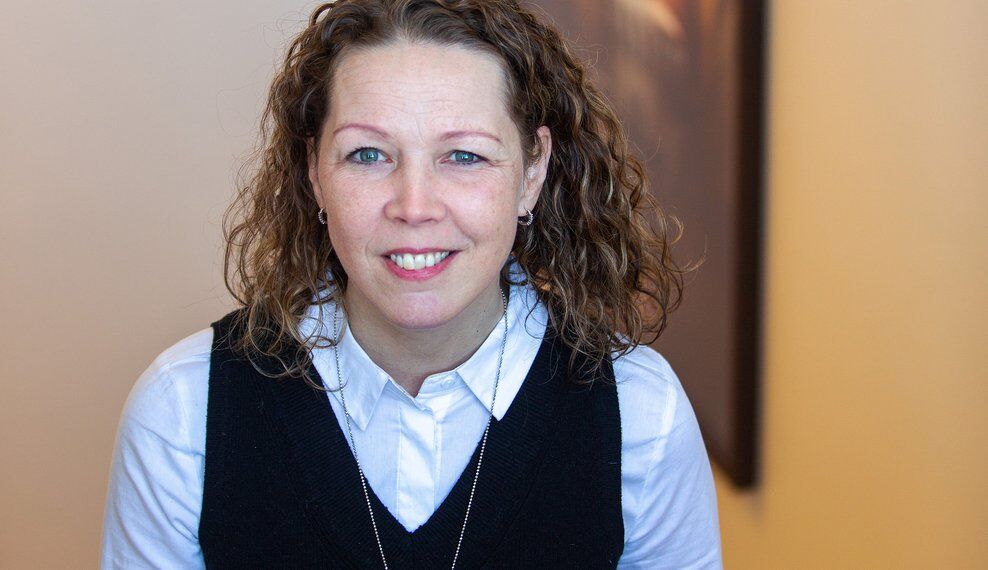
Hrönn Hilmarsdóttir says there has been significant progress and development in services for disabled people in Hafnarfjörður. FRÉTTABLAÐIÐ/VALLI„
For a time, everything in society was more or less closed, and disabled people could not go to work or carry out other daily activities. More people were needed to staff the homes, as everyone was at home all day. We therefore decided to redeploy staff from workplaces, habilitation centres and other day services. Some were responsible for phoning people who lived alone to check on them and so on. Other staff went into people's homes to look after them, and so on. This required a great deal of organisation and for staff to be prepared for a change of role,“ Hrönn informs.
International awards
„Naturally, it wasn't suitable for all residents not to be able to get out and about and to have very little variety. We therefore had to find solutions and new ways. For example, the Wasps, an innovation and employment training programme for disabled people, set up „our little café“ when all the other cafés were closed. People with disabilities could book an appointment at the café, thereby breaking up the monotony and doing something enjoyable. The Wasps received a European award for their work in 2017 and the Múrbrjótinn award in 2018. What sets them apart is how individualised their service is. All service users have a personal timetable, which is set up according to each individual's interests. “This is how we strive to give users the opportunity to expand their experience and knowledge across a wide range of areas of working life,“ adds Hrönn. The City of Hafnarfjörður established a new residential unit at the end of summer 2020, another in 2021, and now in March 2022, yet another residential unit is being launched, but with a different format than has been done before."
A new form of settlement
„The idea for a new form of living arrangement came about when several parents of young people with Down's syndrome were discussing the future of their children. They put the idea to the local council, who welcomed it. In 2019, an agreement was signed between the City of Hafnarfjörður and the Vinabær operating company for services for the residential complex, with the city covering the costs of its operation. Þroskahjálp built the terraced house with six flats, plus staff facilities in the centre of the building. The residents each rent their flat from Þroskahjálp. The operating company, Vinabær, is owned by the residents themselves, and they will therefore take full part and have a direct influence on the policies and priorities of the service. The agreement is unprecedented in this country. The residents know each other well, have been friends for many years, and are ready to move out of their family homes into their own property. For example, the residents have had a say in the recruitment of staff. The director and the ward manager conducted the recruitment interviews, and applicants were given the opportunity to say something specific to the residents. The manager, the ward manager and all the residents held a meeting together where all the job applications were reviewed, the residents were shown photos of the applicants and their feedback was taken into account. The residents then had the final say on which staff would be hired. This is a very exciting project to follow,“ she says.
Non-traditional communication channels
Innovations have emerged, and among these, the habilitation centre in Bæjarhraun, which serves disabled people with a focus on non-verbal communication methods and a sensory-stimulating environment, has undergone significant development. „A distinguishing feature of the habilitation centre is, and has included, the individualised use of communication device controls for computers. Before the advent of communication aids, the „computer interface“ was specially designed and built for users, and it was necessary to seek an overseas partnership for this to be feasible. It was considered remarkable over 25 years ago to control a computer with tongue and eye movements. Now, the staff and users of the service at the rehabilitation centre are in extensive international collaboration.
Among other things, it is being developed as Bliss, a pictorially recognised language based on semantics. Users of the Bliss language most often do not use conventional speech and/or use it to support unclear speech.
The habilitation centre is frequently approached for demonstrations of the use of Blissymbolic, as well as the „computer communication equipment“, which is highly sophisticated and is controlled, among other things, by eye and head movements. The training centre is now preparing for another international collaboration, with the aim of securing an Icelandic/Hafnarfjörður specialist who will run a course on another form of non-traditional communication, namely Intensive Interaction. At the same time, it is an opportunity to create a specialist from our excellent staff team who could share their knowledge beyond Hafnarfjörður. Expression is part of the fundamental human rights of everyone, everywhere,“ says Hrönn
An interview with Hrönn was published in Fréttablaðið on Thursday, 3 March 2022.