
The impact of changed quarantine rules on school activities
The Minister of Health has made changes to the rules on quarantine and infection control, which came into effect from midnight. The following rules on quarantine and infection control now apply in connection with school activities.
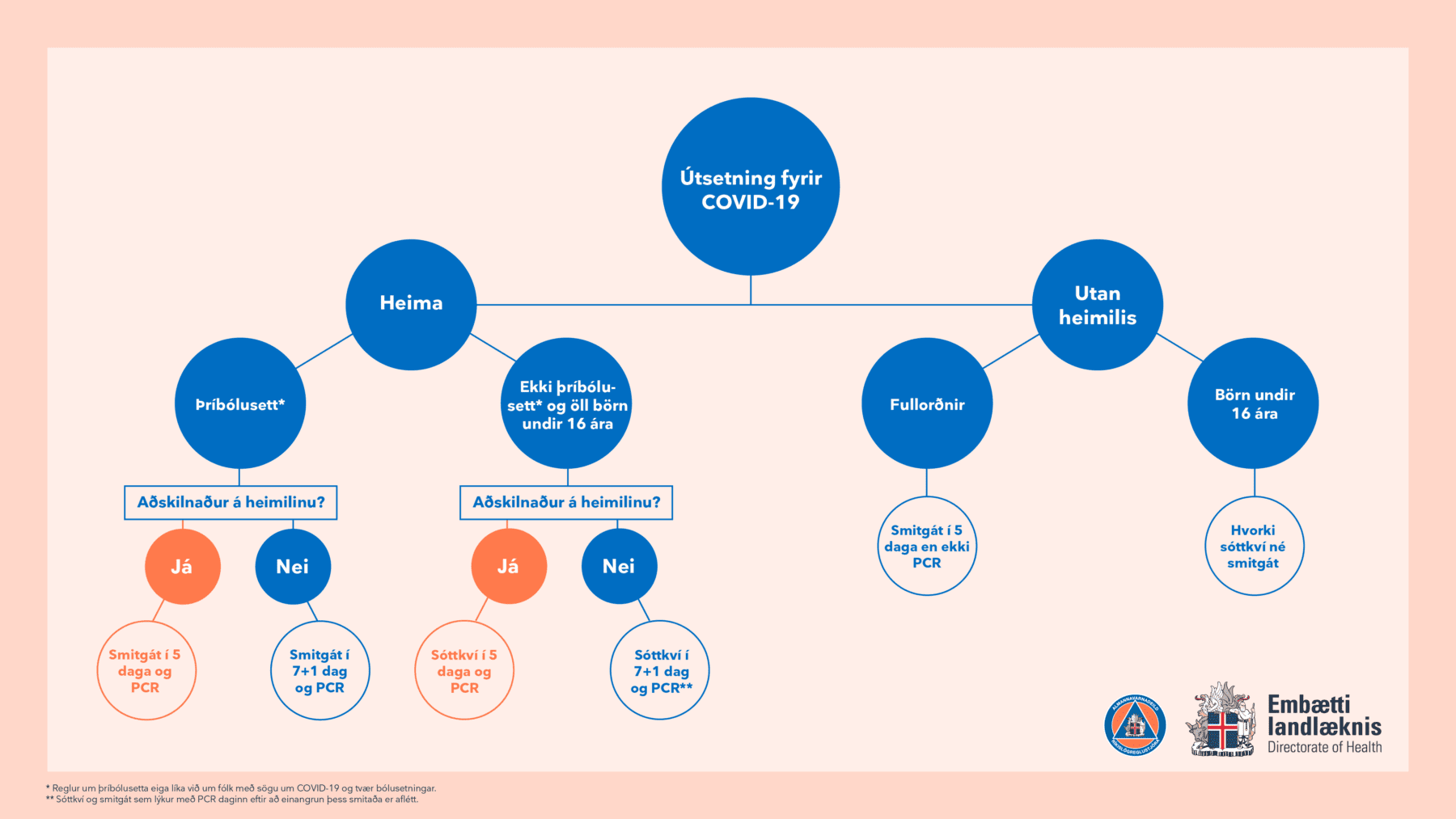
The Minister of Health has made changes to the rules on quarantine and infection control, which came into effect at midnight. The changes do not affect Regulation No. 6/2022 on the restriction of school activities, which remains in force until Wednesday, 2 February.
See the announcement on the website of the Cabinet Office.

The following rules on quarantine and infection control now apply in connection with school activities:
Nursery, primary and secondary school and leisure activities
- Children of preschool and primary school age, born in 2006 or later, who have been exposed to a COVID-19 infection outside the home, e.g. at school or in sports or leisure activities, do not need to self-isolate or take any special precautions. However, if they have been or are living with a person in isolation in their home, they must go into quarantine. Quarantine for an infected person in the home will therefore remain in effect.
- Adults who are exposed to an infection outside the home, e.g. at school, are placed under contact tracing. This involves wearing a face covering in crowded places and when it is not possible to maintain a 2-metre distance, whether indoors or outdoors, and avoiding contact with vulnerable individuals. The period of self-isolation lasts for 5 days, and no longer requires a test to be lifted.
- Throughout the pandemic, the procedure for contact tracing has been that when a case of infection has been identified within a school, parents/guardians have been informed. With the change that comes into effect now, this will change, as tracing within the school will no longer be necessary and parents/guardians will only report their children's illnesses.
Secondary schools
- Secondary school pupils who are exposed to infection outside the home, e.g. at school, are placed under infection control. This involves wearing a face covering in crowded areas and when it is not possible to maintain a 2-metre distance, both indoors and outdoors, and avoiding contact with vulnerable individuals. The period of self-isolation lasts for 5 days, and no further testing is required to be released from it.
Traditional contact tracing has been discontinued
- These changes mean that traditional contact tracing has been discontinued in nurseries, primary and secondary schools from midnight. The quarantine for those pupils who are already in quarantine will be lifted from the same time, provided they meet the conditions.
More about quarantine
- If a student is required to quarantine because they were exposed to COVID-19 at their place of residence, e.g. in the same household, they must continue to quarantine. However, if the quarantine is lifted because a student was in contact with a person with COVID-19 outside their place of residence, e.g. in a classroom, the student's quarantine will be lifted under the regulatory change. This only applies to children born in 2006 and later. Children born in 2005 and earlier, and adults, will then enter a period of self-isolation. However, there is an exception for triple-vaccinated individuals (a positive test counts as one vaccination) who are exposed in a household setting.
- With the change in regulations, a person in quarantine will no longer be permitted to attend school. On the other hand, individuals who are triple-vaccinated (or double-vaccinated and have had a recent COVID-19 infection) will generally not be required to quarantine but will instead be expected to practise infection control. Parents in such a situation are permitted to bring their child to school.
- The amendment to the regulation does not involve any change to the obligation for individuals with links to Iceland who are arriving from abroad to undergo a test for the diagnosis of COVID-19. However, such an obligation has not applied to children of nursery and primary school age, pursuant to paragraph 4 of article 7 of the regulation, and is not intended to be changed.
Teachers could continue to practise social distancing
- A memo from the Director of Public Health states that teachers are encouraged to take good care of their personal hygiene, and to use virus-resistant masks and face shields, especially if they have not received a booster dose (third dose) of the vaccine. The full effectiveness of a booster dose of the vaccine is not achieved until 14 days after vaccination.
- People are still encouraged to remain vigilant for symptoms and to take a PCR test.
- See also the press release from the Ministry of Health on the website of the Cabinet Office.
Further information
School governors provide information on the arrangements for teaching and public health measures at each school. Enquiries from the school community about public health measures in nurseries, primary and secondary schools, and the guidelines in light of COVID-19 can be sent to the following email address: covid19@mrn.is
Answers to common questions
Here you can find answers to questions that the ministry has received regarding the proposed changes to quarantine and infection control.
- My child is currently in quarantine – what does this mean? Can my child attend school and after-school activities tomorrow? Yes, unless the child is in quarantine due to an infection in the household.
- My child is currently in isolation – what does this mean? Can my child attend school and after-school activities tomorrow? No.
- My child is currently in quarantine – what does this mean? Can my child attend school and after-school activities tomorrow? Yes.
- My child is due for a PCR tomorrow – do they need to attend? Yes, if the child is in quarantine due to an infection in the household. If not, it is still advisable for the child to have a PCR test.
Photograph: Haraldur Jónasson / Hari on the website of the Stjórnaráðið