
The West End as a conservation area – covers a number of houses
In the West Town, there are already a number of buildings that fall under the laws on cultural heritage. The first of two consultation meetings on the planning work, which concerns on the one hand the West End of Hafnarfjörður and on the other a Conservation Area in an urban setting, was held at Hafnarborg on 5 March, and the second will be held on Tuesday, 31 March at 17:00.
In the West End, there are already a number of buildings that fall under the law on cultural heritage.
The first of two consultation meetings on the planning process, concerning the Vesturbær area of Hafnarfjörður and a Conservation Area in the town, was held at Hafnarborg on the 5th. March, and the second will be held on Tuesday, 31 March at 5 p.m. and will be live-streamed on the City of Hafnarfjörður's website and Facebook page. At that meeting, an ideation process concerning the area's detailed plan will be presented to the residents of Hafnarfjörður, who will have the opportunity to view it and ask questions during the live stream. The local newspaper Hafnfirðingur spoke with Gunnþóra Guðmundsdóttir, an architect and project manager at the Department of Environment and Planning.

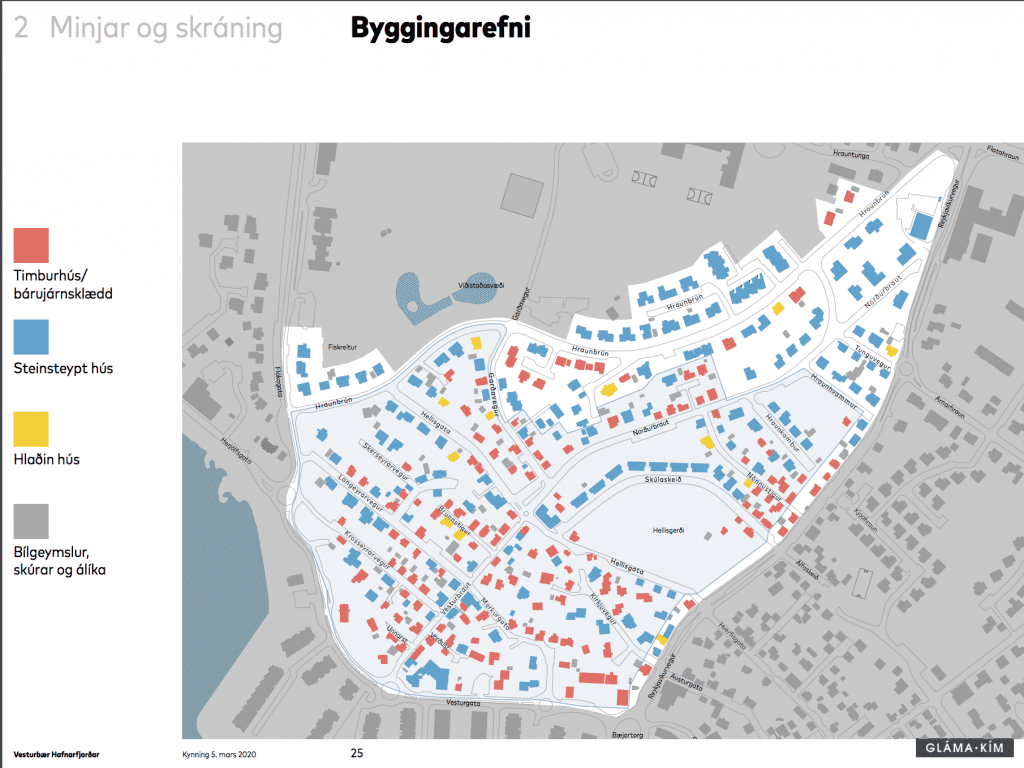
Map of the West End
When a new or revised detailed plan is prepared, a building survey and an archaeological survey must be carried out, which the National Heritage Board must then approve. The Hafnarfjörður Folk Museum and Gláma Kím architects have been working on a building survey for the West Town, where all the houses within the planning area are being recorded. The building survey will be made available to residents in due course, as the work is now nearing completion.

From the presentation on the West End as a conservation area
Planning work began in 2016, which involves the revision of the Vesturbær local plan. It is intended that part of the planning area will be designated as a Conservation Area in accordance with the Act No. 87/2015. The aim of the conservation area is to promote the protection and preservation of a built-up area of historical value. „In accordance with the law on conservation areas, which came into force in 2015, we as a municipality must identify an area that we intend to designate as a conservation area. We therefore felt it was ideal to choose the West End, as it is unique in the country.
Conservation of houses has a positive effect on their sale value.
With a conservation area in an urban setting, Gunnþóra says that a sort of recipe is being created, and people can look up information and consult a guidance manual so that they can take the right approach to making changes and improvements. „It doesn't matter whether a house was built in 1880 or 2000, you always need permission to alter houses. In the West End, there are already a number of houses that fall under the legislation on cultural heritage.".

Year of construction of houses in the West End
In reality, there are three categories concerning the houses. Houses built in 1925 and earlier are subject to consultation. The National Heritage Institute of Iceland provides an opinion which is advisory. Houses that have reached 100 years of age are protected, and it is not permitted to approve alterations to them without the consent of the National Heritage Institute of Iceland. Then there are the listed buildings, a category which includes all buildings that were protected before the new law came into force in 2013. Buildings are listed by the signature of a minister, following the relevant preparatory work. Listed buildings are independent of age but may have historical value or are considered architecturally significant. The protection of buildings has often been misinterpreted as something negative, but in reality, it places them on a certain pedestal. As such houses are well-maintained, this has had an effect on the sale prices of other properties in the same street. There are various reports from abroad which demonstrate the value of the built heritage. (Realdania; The Value of Built Heritage, March 2015).
Gunnþóra says that there are quite a few people who want to alter houses in this area, for example, extending tiny timber houses when modern household appliances won't fit into the spaces. „It is also a form of heritage conservation to channel such matters into a process, as conservation can also mean that the buildings are in use, fulfilling a certain function. When reviewing the local plan, these factors need to be considered, such as where it is possible to extend and in what way. The local plan and the Conservation Area must then go hand in hand.”

A good job has been done here.
In close consultation with local residents
The next meeting will be streamed on the website and Facebook page of the City of Hafnarfjörður. Tuesday, 31 March at 5 p.m.. „We are trying to bring all of this together in light of the situation that has now arisen. The idea is that people can then sit at home and type in questions, which will be answered promptly, and people will be given space afterwards to familiarise themselves with the issues. We want to do this in close consultation with local residents and other residents of Hafnarfjörður. Residents often give us a nudge as they often know the area better than we do. Once this has been put together, the detailed plan will be published, and residents will then have another opportunity to make comments. People don't always understand drawings, so they're always welcome to get in touch with us here or pop in. We really want to get people involved,“ says Gunnþóra.
An interview with Gunnþóra was published in Hafnfirðinginn on 19 March 2020.