
Five minutes to get the students' attention
At Hvaleyrarskóli, maths teacher Arnar Sigurjónsson has launched the 'Thinking Classroom' project. The idea is simple but challenging to put into practice: to get students thinking, discussing and experimenting straight away — before they are fed too much information. Arnar assumes that a teacher does not have long to win students over.
Working with your own solutions
At Hvaleyrarskóli, maths teacher Arnar Sigurjónsson has launched the 'Hugsandi skólastofa' project, which received a grant from the Hafnarfjörður Education Fund. The idea is simple but challenging to implement: to get students thinking, discussing and experimenting straight away — before they are fed with too much information. Arnar assumes that a teacher does not have long to get students on board. In fact, he says that students' attention spans are typically only about five minutes. Therefore, the teacher needs to start clearly and simply. Complex mathematical problems often need to be broken down into the simplest possible units. Students only need basic information at first to get started. This is followed by a process where they try things out, discuss, spot patterns and gradually build upon their understanding.
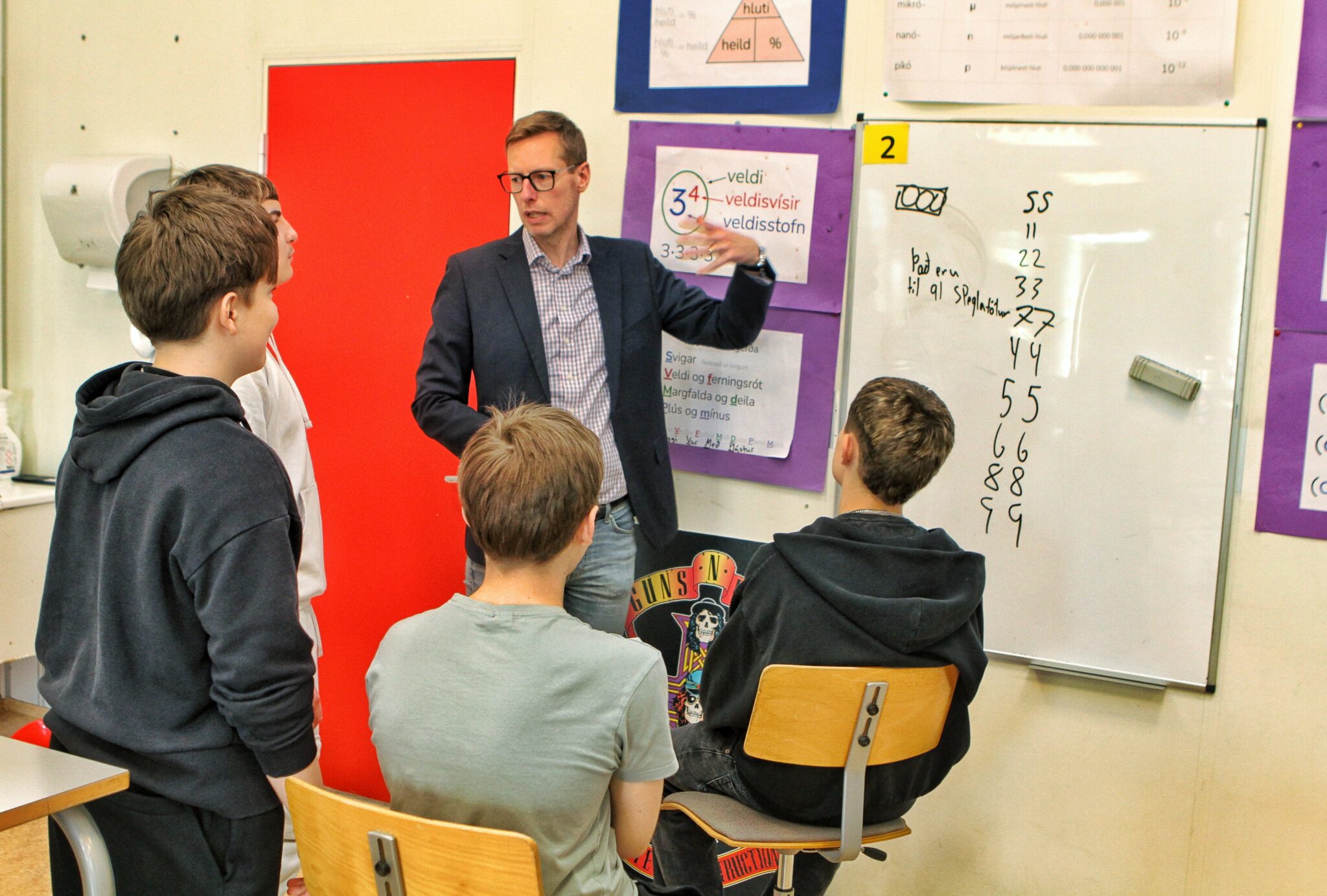
The aim is not for the teacher to explain everything from the outset, but to get the thinking started.„You mustn't feed them too much.“ Arnar says of the approach. Students need to be given a clear enough structure to know what they are supposed to do, but not so much explanation that the task is solved for them before they even begin. In the classroom, mobile phones are not part of the work, as there is a mobile phone ban in the school. However, that does not mean that students work without aids. Calculators are permitted when appropriate. The difference is that the technology is not meant to take over the thinking. It is meant to support the work once students have started to develop their own solutions.
A method that has developed over many years
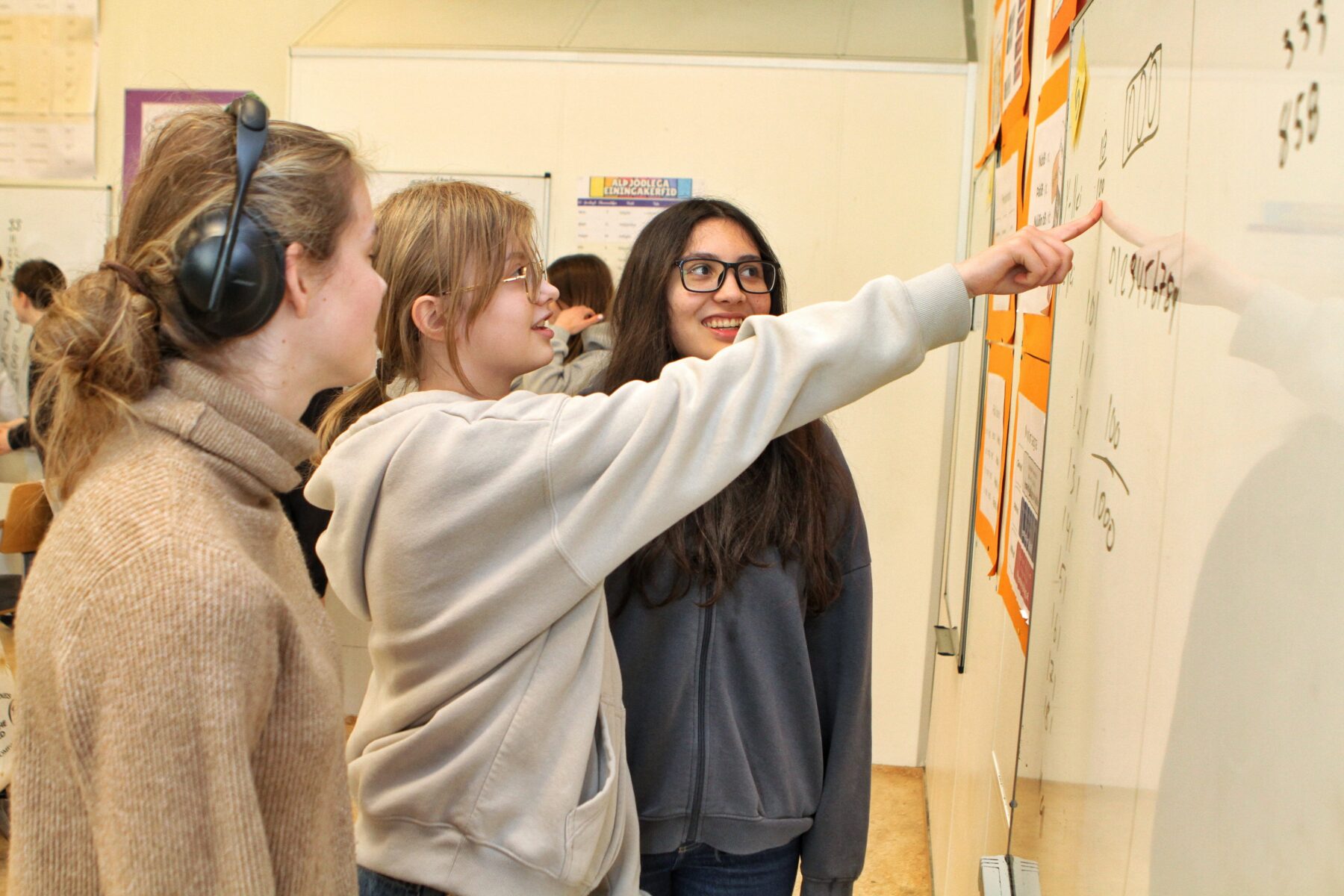
A thinking classroom is not an experiment that is created from nothing in a single lesson. According to Arnar, the method has been developed widely in recent years and is based on the idea that students learn better when they are active, talk to each other and work visibly with their ideas. Instead of sitting at their own desks and working in silence, students are put into small groups. They stand at vertical, wipeable surfaces (e.g. whiteboards), discuss together and write their solutions in a way that makes their thinking visible, both to themselves, the teacher, and other groups.
Arnar says that this visible work makes a big difference. When students are sitting at their desks, it can be difficult to see what is going on in their heads. At the whiteboards, however, the ideas become visible. The teacher can then walk around, ask questions, prompt and intervene without taking the task away from the students.
More activity in the living room
One of the main benefits, according to Arnar, is increased engagement. In a traditional classroom, a teacher can stand in front of the group and find that only some of the students are actually working. Some sit with them, others fall off, and the teacher has to constantly try to bring them back in. In Thinking Classroom ...sees it differently. There, the majority of the group are active for the greater part of the time. That doesn't mean that everyone is always fully engaged. Arnar doesn't assess the method in that way. But he says the difference lies in more students doing something, discussing something and trying something. That alone changes the lesson.
Cooperation that needs to be practised
However, working in groups is not the same as simply putting students together and hoping for the best. Arnar emphasises that collaboration is a skill that needs to be practised. Students need to learn to listen, suggest ideas, respond to the ideas of others and take part in a joint problem-solving process. This doesn't all happen in the first lesson, but rather builds up steadily. Gradually, the concepts and working methods become part of the classroom culture. Students get used to starting by thinking for themselves, discussing with one another, and trying out solutions before they wait for the correct answer from the teacher.
Arnar has been experimenting with group sizes and believes it is important that they are not too large. It seems best to have two to three students together. When the group becomes four people, there is a risk that it will split into two smaller groups, or that some will become more inactive. It is better to split them into pairs straight away. This group size creates a better balance. Students have enough company to discuss ideas, but the group is still small enough that everyone has to contribute.
Not an expensive procedure
Although the idea might sound as if it requires a lot of equipment, Arnar says that this doesn't have to be the case. You don't necessarily need expensive tablets or complicated technology. A simple, reusable tabletop and good projects can go a long way. In his opinion, the method is primarily about pedagogy, organisation and the culture in the classroom. It is even an advantage that the implementation can be simple. Once the boards or reusable surfaces are in place, they can be used again and again.
The thought will become common
In the lesson, it quickly becomes clear what Arnar is aiming for: for students' thinking not to be hidden in notebooks or inside each person's head, but to be shared and visible. When students stand at the boards, write down their experiments and see the solutions of other groups, mathematics becomes a conversation. The teacher can see more clearly where misunderstandings arise, students see that more than one approach can be possible, and the classroom becomes more dynamic.
In recent weeks and in the coming weeks, interviews with grantee from the Hafnarfjörður Education Fund be published on the media channels of the City of Hafnarfjörður. This gives residents and other interested parties the opportunity to gain a deeper insight into the excellent projects and creative school and leisure activities.