
Freedom of expression is a fundamental human right for all.
At the Skills Centre at Bæjarhraun 2, the emphasis is on structured services and training in the use of non-verbal communication and sensory stimulation, leading to an improved quality of life. 23 users attend, either from 8 am to 12 pm or 12 pm to 4 pm, where the service is individually tailored and guided by a plan and daily schedule.
Í The training centre at Bæjarhraun 2 Emphasis is placed on structured services and training in the use of non-traditional communication and sensory stimulation, leading to an improved quality of life. 23 users attend for work, either from 8 am to 12 pm or 12 pm to 4 pm, where the service is individually tailored and guided by a plan and daily schedule. A Hafnfirðingur paid a visit and spoke with Halla Hörpu Stefánsdóttir, Head Occupational Therapist.
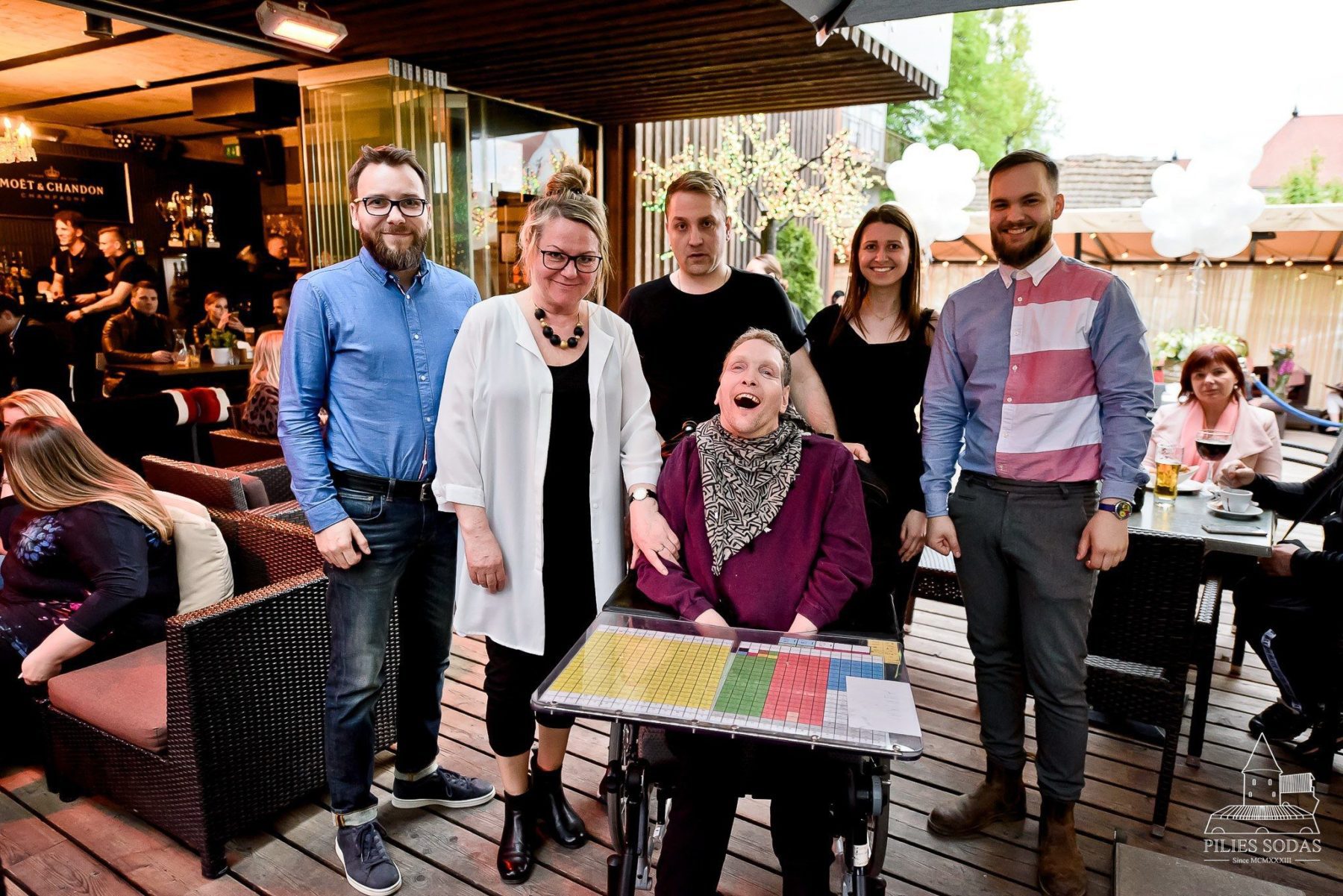
 Representatives of The Training Centre in Lithuania, where they took part in an Erasmus+ project entitled „Communication is the Path to Integration“. In the picture, from the left: Andrius, Halla Harpa, Snorri, Ingrid, Eyþór and Sigurjón „Blissari“ at the front of the picture.
Freedom of expression is a fundamental human right for all.
„I've been here from the beginning and I'm proud of that. This is a specialised place when it comes to this chain of service, which is widespread around the world.“ says Halla. The training centre has been run by the City of Hafnarfjörður since the beginning of 2011, but prior to that it belonged to the Regional Office for Disability Affairs in Reykjanes, from the beginning of 1991. The emphasis has always been on empowering service users with long-term support needs in the use of alternative and augmentative communication (AAC). In most cases, users have been using the Blissymbolics language since childhood, which consists of around 5,000 symbols used for communication. „There are on-screen pointing devices on tablets and/or laptops and tablets, which are often controlled, for example, with an eye-tracking device or a head-mounted device. It depends on the user's motor ability.“ Part of the Bliss system. Charles Bliss (1897-1985), who designed the Bliss system and initially the Bliss language, was of Jewish descent. He was a chemist and had a great interest in Chinese characters. He believed the problems of the war-torn world were due to communication difficulties and wanted to “save” the world. He grew up with three languages and felt it was unfair that, as a six-year-old, he had to learn them all. He never had disabled people in mind, although many of them use his language today.

Currently, 23 users attend the Training Centre each week, with most coming daily between 8 am and 12 pm, and 12 pm and 4 pm. In addition, several come two to three times a week for communication training. „For example, seven people from Reykjavik come here because the service is not available in Reykjavik. I have said for at least 30 years that being able to express oneself is the most important thing there is. At Hæfingarstöðin, we have the value that expression is a fundamental human right for everyone.“ says Halla, adding: „Being able to practise your expression for four hours a day is the equivalent of a job. We work from an individual plan, and a clear work plan is drawn up each year. We have extensive experience in non-verbal communication and the use of technology, and have travelled widely around the world to conferences both to participate in the development of the Bliss language and its technical equipment.“
At the Development Centre, great emphasis is also placed on ensuring the environment is appropriate, and there are, for example, special rooms furnished to provide sensory stimulation. The group that comes to us is divided into two, although there is a great deal of crossover, because the underlying conditions are different. This has changed a lot since I became an occupational therapist in 1980. We always strive to be exemplary in our service to this group, i.e. people with long-term support needs.“ says Halla in the end.
This article was first published in Hafnfirðinginn on 22 November.