
The works at the library – getting to know them better
Numerous works of art adorn our brand-new library for the people of Hafnarfjörður. The opening ceremony was held on Thursday. Hundreds of people came to visit. The library is surrounded by culture and art. Let's take a few examples and get to know some of the works found there a little better.
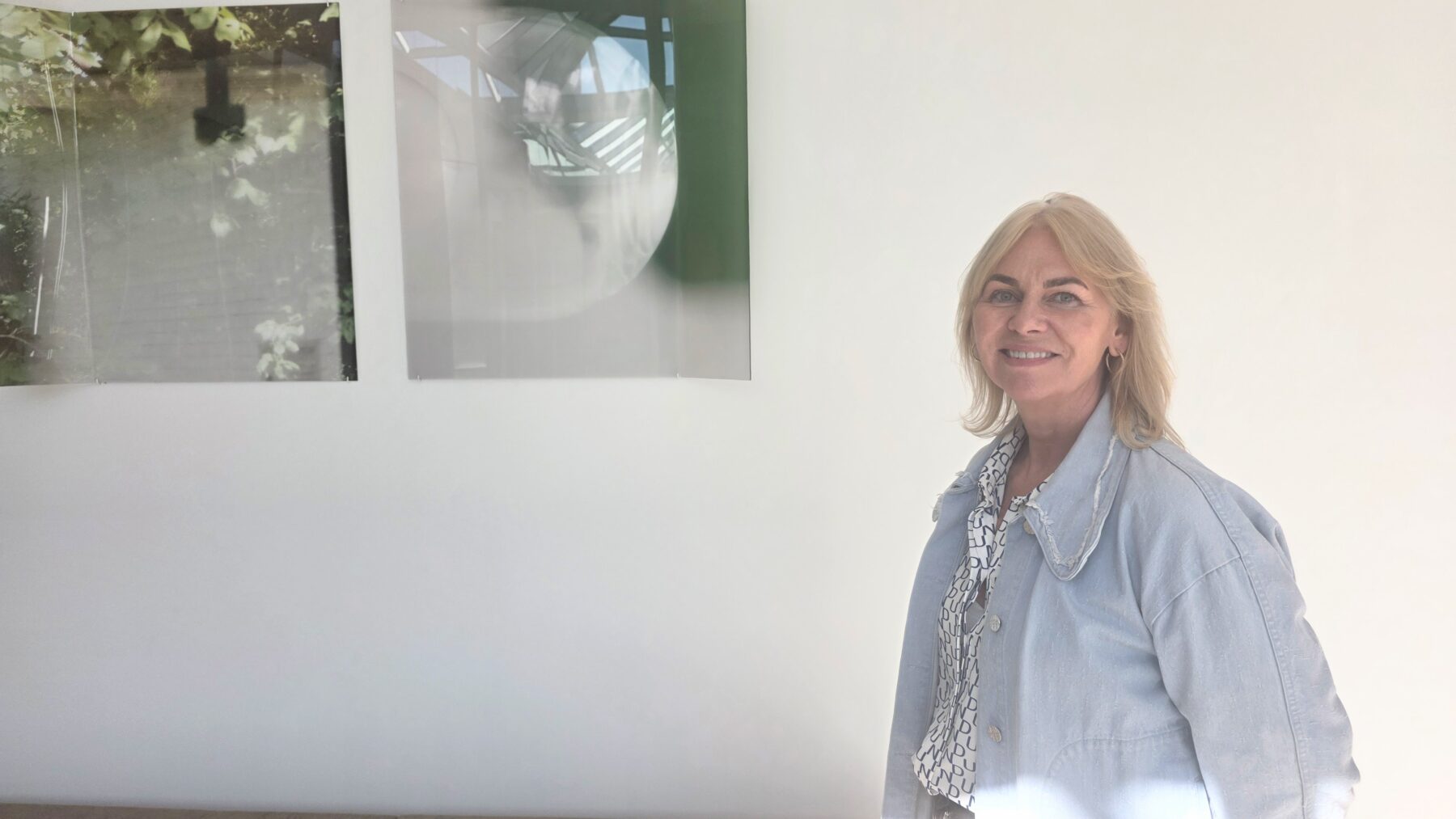
Art at the library
Selected works of art adorn the walls of our new library. Aldís Arnadóttir, director of Hafnarborg, guides us through the library and gives a very brief introduction to some of the selected works on display.
Yes, the works are as varied as they are numerous. Those of you who come up the escalator will most likely notice a large blue and black piece that catches the eye. It's called Blue description after Trond Patursson.
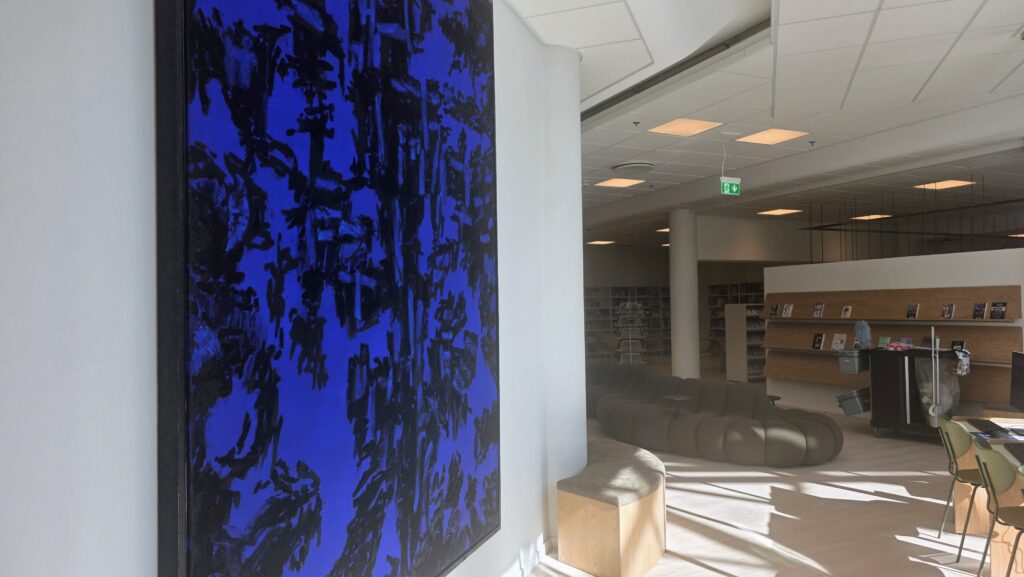
„Tróndur is one of the most well-known living Faroese artists,“ says Aldís.
„He has works in public buildings across the Nordic countries and has exhibited widely around the world. He often works on a large scale and deals with sculpture, installations and paintings alike. He is probably best known, however, for his glass art,“ she says.
She says Trónd often works with light and the interplay of light and colour. „He draws his inspiration from nature, the sea, the wind, the birdlife and the landscape of the Faroe Islands.“
The work was in a show at Hafnarborg in 2002. „It hasn't been shown for a long time. So it's incredibly nice to have it in such a beautiful place here.“
It is particularly pleasing in the daylight that streams down through the skylights. „Depending on the weather and lighting conditions, people will see different shades of blue and a light that seems to come from within the work,“ describes Aldís.
The works reflect the activity
Many of the works are well suited to the library's activities. „Here, for example, is a work by John Laxdal “which was previously in the old library building," she says.
„It is very interesting to connect this work with the library's activities, because it is related to concrete poetry. Jón works with newspaper cuttings, letters and typography. That is why the work is very appropriate here at the library,“ she says, adding that Jón was one of the Icelandic artists who worked most prolifically with this type of work. He died in 2021.
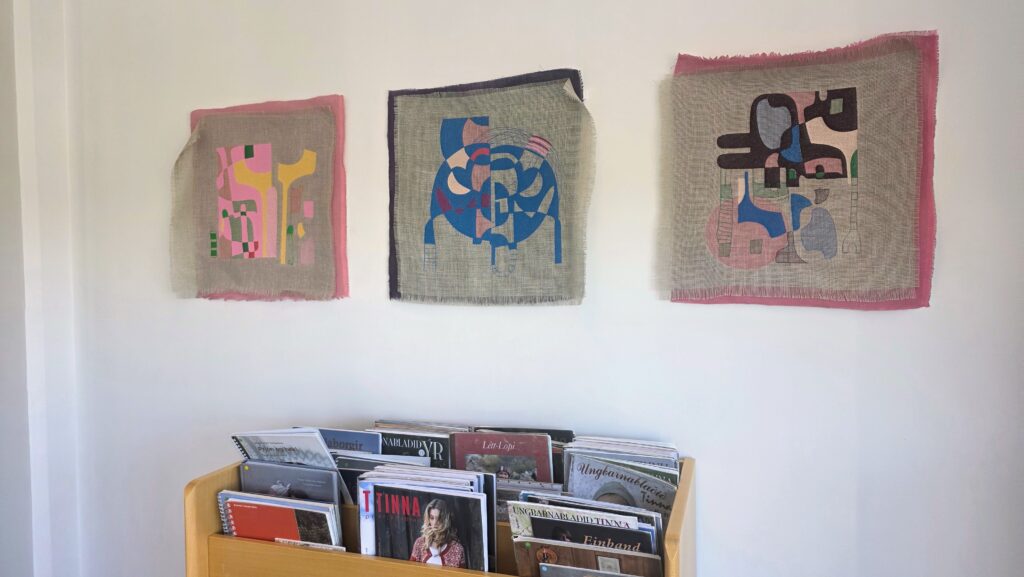
In the seating area at the far end of the new library, you can find textile works by Ragnar the Wise. „These are brand-new works by Ragna in the Hafnarborg collection,“ says Aldís, "and it's particularly nice to have works on a subject related to handicrafts.".
„Ragna works at the boundaries of craft, design and fine art. These are textile works where she uses a sewing machine, but she applies it in the same way a painter uses a brush, sewing the image into the grid.“ This is very characteristic of her work.
„The works feature patterns that are both exotic and familiar at the same time. The patterns often refer to something ancient, and the works were on show at our exhibition earlier this year.“
Aldís says there are many abstract works in the exhibition space. A kind of living dialogue forms between the works. „And that, even though they weren't necessarily conceived together as a single whole,“ says Aldís.
She gives an example. „In one of the works, you can see how the light comes in from behind it. There's a neon colour that appears more intense or duller depending on the light.“
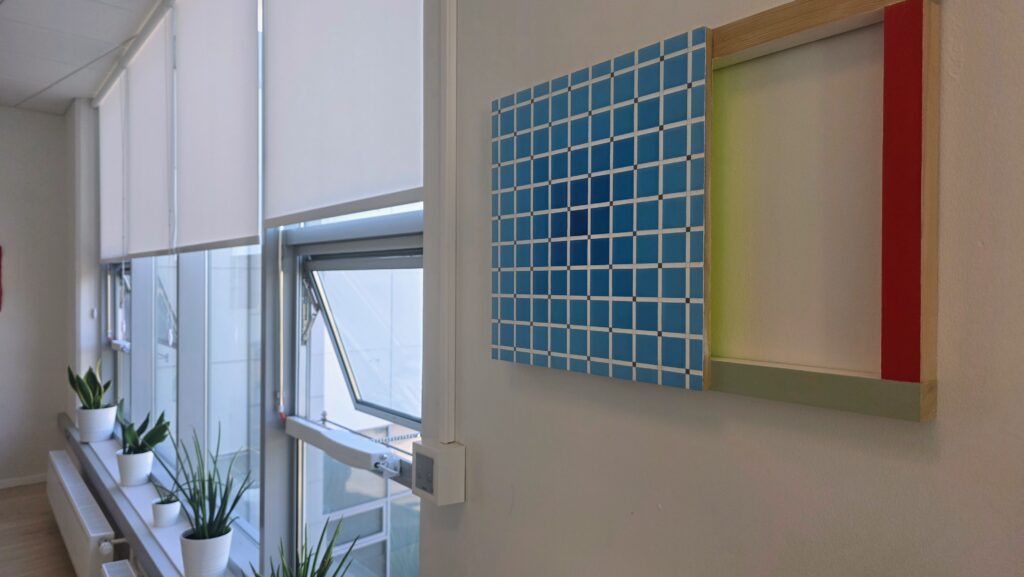
The work is by Ingunni Fjóla Ingþórsdóttir which works a lot with the viewer's perspective. You instinctively start to move around the work and look at it from different angles,“ she says.
Then we move forward again, but alongside the large work by Trond can be found two untitled works.
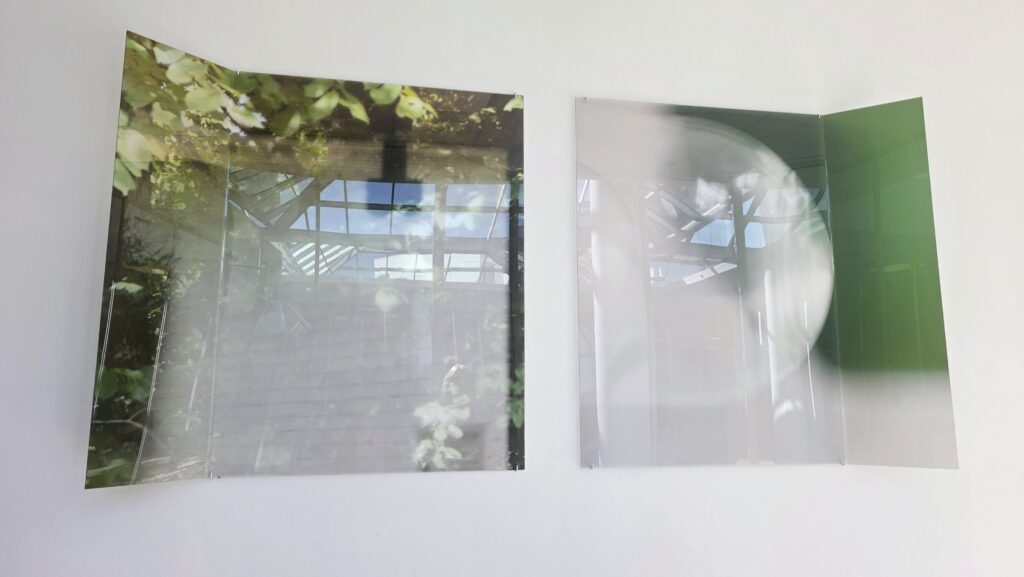
„These are works by Thordis Jóhannesdóttir which were on display at the Árnessingasafnið art museum a few years ago. “Þórdís often takes photographs of other artists' works or finds a perspective that captures her in some way," says Aldís, mentioning how Þórdís presents the photographs on Perspex.
„The works are therefore both photographs and sculptures, but the Perspex is bent and the light gives the works an added dimension. Shadows are cast depending on how the sun shines and how the light falls on them. Then colours and shadows appear around them,“ says Aldís. This very quality can be seen in the photograph that accompanies this text.
„These works also show that a photograph does not have to be merely a two-dimensional surface. Here, the boundaries become blurred and the work becomes a kind of Photographic sculpture. The viewer instinctively moves around the work and examines it from different angles.“
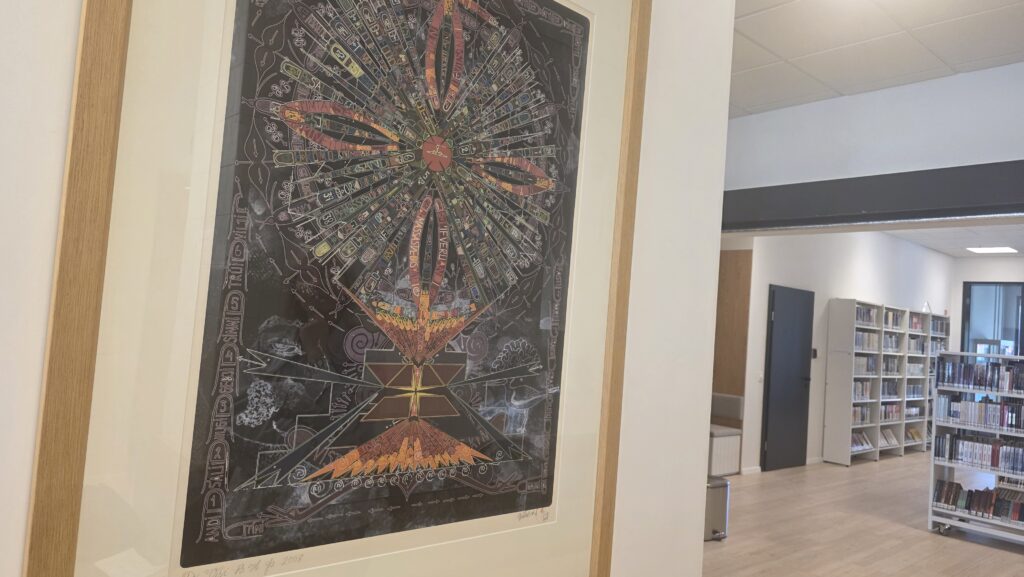
She next leads us to the work. Indicator roses. This is a work by Bjarni Thórarinsson who made a series of pictures with this title in collaboration with Good “but they have both recently passed away," she says.
„Indicators It is a kind of visual world where language and meaning are worked with in both a scientific and an aesthetic way. This is not only a theoretical analysis of the language, but also its visual representation. “The work has to be read,' she says.
„The words are linked to one another, and one word leads into the next line. This is a kind of investigation of words. Everything here follows a specific, well-thought-out formula or system. There, for example, one can read words such as and, soul, mind, mental health, their turn, faith and will. You could even spend a whole day looking at the work,“ she says before she leads us to the children's corner of the library, where works by Erik Smith.
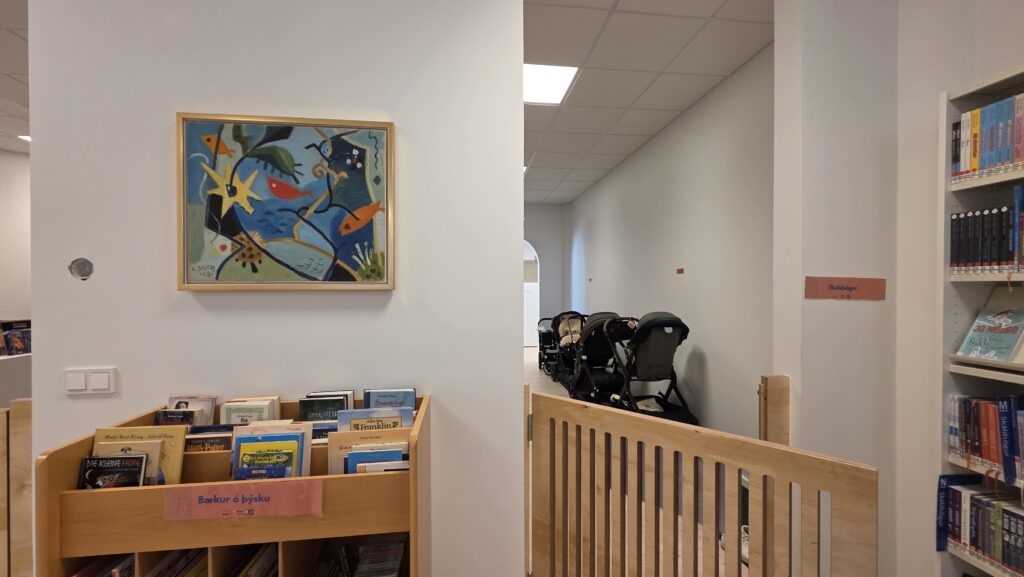
„This work is from 1948 and is called Japanese poem. “I think it was likely at Erling Smith's first solo exhibition, which was held in the old Sjálfstæðishús building on Strandgata," she says.
„It's a nice connection that the work now has a place in a new location on Strandgatan. It's quite different from the works that many people know by Eirík, as it's from the beginning of his career, just before he started creating very abstract paintings.“
Works for every space
But how were the works chosen for the library? „We took some time over it,“ says Aldís. „We thought about what would fit in the space, what would welcome visitors, and which works would resonate with the library's activities.“
The works now have a good home at the library. „But of course, it's always possible to swap the works out. The library is meant to be a living space, and we imagine the works can be here for a certain period of time, like an exhibition.“
Aldís says in conclusion that the new library is a great way to introduce the collection of Hafnarborg to visitors and passers-by.
„I hope that the townspeople and visitors to the library enjoy the works. So many people come here, and it's wonderful that visitors to the library can enjoy them here.“
Yes, come to the new library – it is truly an adventure for us Hafnfirðingar!